Policy by Template, Risk by Design: How Schools May Be Drifting Out of Compliance with the New RSHE Guidance

With revised statutory guidance on Relationships, Sex and Health Education (RSHE), issued in July 2025 and due to come into force in September 2026, schools are now entering a critical transitional phase of policy alignment. A serious question must therefore be asked: are some of the very policy templates relied upon by schools placing them at risk of future non-compliance with the law?

This question has moved from abstraction to reality following concerns raised about model RSHE policies circulated by The Key, a provider whose materials are widely used across English schools and trusts. Where such organisations position themselves as authoritative sources of compliant policy, the implications of their wording extend far beyond individual institutions.

This is not a theoretical concern. It arises from the growing use of model RSHE policies produced by external providers and adopted—often with minimal amendment—by governing bodies across the country. The issue is not whether such providers intend to mislead, but whether the language embedded within their templates can be reconciled with the statutory framework schools are required to follow. This is therefore not a post-compliance critique, but a pre-implementation warning: the language schools adopt now will determine whether they are compliant when the guidance takes effect.

The stakes are higher than many realise. This is not merely a matter of educational philosophy. It is a question of legal compliance, safeguarding responsibility, and governance accountability.

Statutory Guidance Is Not Optional
The starting point must be the legal status of the RSHE guidance itself. The Department for Education is explicit: this is statutory guidance issued under the Education Acts, and schools “must have regard to the guidance,” meaning that any departure requires clear, reasoned, and defensible justification.¹ This establishes not merely a recommendation, but a binding interpretive framework within which policy must be formed.

The responsibility for ensuring this compliance does not lie with external providers, however influential, but with those charged with governance. The guidance is addressed directly to governing bodies, trustees, proprietors, and senior leadership teams, who bear ultimate responsibility for policy adoption and implementation.²

This responsibility is reinforced by a further statutory expectation: schools must maintain an up-to-date RSHE policy and proactively engage and consult parents, ensuring transparency and accessibility of materials.³

The Critical Distinction: Law Versus Contested Belief
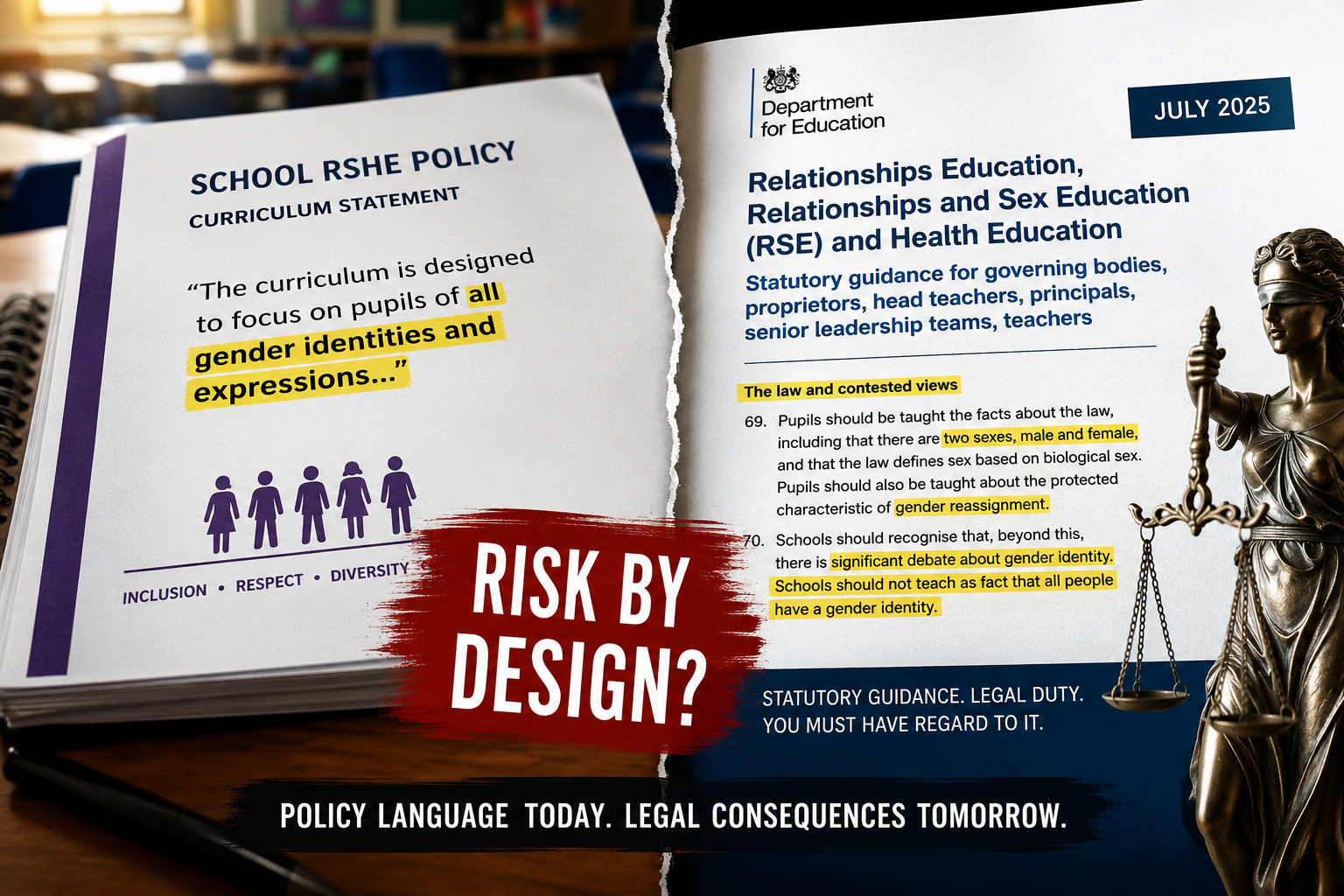
The revised guidance is notably careful—indeed deliberate—in its handling of sensitive and contested subject matter. Pupils must be taught about protected characteristics, including sexual orientation and gender reassignment, in a way that fosters respect and dignity.⁴ At the same time, schools are required to teach the facts and the law, including the distinction between biological sex and gender reassignment.⁵

Crucially, the guidance introduces a limiting principle: schools must recognise that beyond the law there is “significant debate” and must not present any particular view as settled fact.⁶ This is made explicit in the directive that schools should not teach as fact that all people have a gender identity.⁷

This is reinforced elsewhere in the guidance, which emphasises that RSHE must equip pupils with knowledge of the law and that teaching must remain grounded in factual, evidence-based content rather than ideological assertion.⁸

Where Template Policy Language Becomes Legally Vulnerable
It is precisely at this point that difficulties arise with certain externally supplied policy templates, including those attributed to The Key.

A commonly circulated formulation states:

“The curriculum is designed to focus on pupils of all gender identities and expressions…”⁹

The intention behind such language may well be inclusion. Yet intention is not the relevant legal test. The question is how such wording may reasonably be interpreted in light of statutory guidance.

On its face, the phrase assumes the existence of “gender identities and expressions” as a general and organising feature of human reality. It does not frame this as a contested idea, nor as one perspective among others. It presents it descriptively, as though it were a settled anthropological given.

In doing so, the wording is capable of being read as treating gender identity as an established and universal fact rather than a contested concept. That is precisely the formulation the statutory guidance cautions schools to avoid.

The Equality Act Distinction That Cannot Be Ignored
The legal framework reinforces this concern. The Equality Act 2010 protects the characteristic of gender reassignment, a defined legal category relating to individuals undergoing or proposing to undergo a process of transition.¹⁰

The statutory guidance reflects this distinction with precision, referring consistently to biological sex and gender reassignment as the relevant legal categories.⁵ Where policy language substitutes these with broader and undefined notions of “gender identity,” it risks blurring the line between law and ideology.

For a school, this is not an abstract concern. It goes directly to the requirement that pupils be taught the law as it stands, not as it is reinterpreted through contested theoretical frameworks.

Governance Cannot Be Outsourced
The statutory guidance is clear that governing bodies and proprietors are responsible for ensuring compliance, and that any departure from guidance must be justified.¹² The use of external templates—even those widely adopted—does not transfer that responsibility.

Schools must be able to demonstrate that their policies align with statutory expectations, particularly in light of strengthened requirements for parental engagement and transparency.³

Safeguarding Requires Clarity, Not Assumption
The issue is not solely legal. It is also deeply pastoral.

Keeping Children Safe in Education 2025 defines safeguarding as protecting children from harm and preventing impairment of their mental and physical development.¹¹ It emphasises that safeguarding is a child-centred responsibility requiring careful, informed, and proportionate responses to complex needs.¹¹

The RSHE guidance similarly warns against simplistic approaches, noting that issues such as identity and distress must be handled with care and that teaching must remain evidence-based and developmentally appropriate.⁷

Where policy language implicitly affirms contested frameworks as universal, it risks shaping pastoral responses in ways that are insufficiently cautious. Safeguarding demands clarity, not assumption.

From Assumption to Accountability
What is emerging, therefore, is not a marginal technical inconsistency but a systemic risk.

A single phrase, embedded now, may move a school from anticipated compliance into immediate contestation the moment the guidance comes into force.

The responsibility now rests with governors, trustees, and school leaders to ensure that policy reflects law, evidence, and the best interests of the child.

A school that cannot distinguish between law and ideology cannot claim neutrality; and a policy that cannot withstand scrutiny cannot credibly claim compliance.


¹ Department for Education, Relationships Education, Relationships and Sex Education (RSE) and Health Education (Statutory Guidance, July 2025), para. 5 (“must have regard”).
² Ibid., para. 9 (audience: governing bodies, trustees, SLT).
³ Ibid., paras. 12–13 (policy requirement and parental consultation).
⁴ Ibid., paras. 67–68 (“Lesbian, Gay, Bisexual and Transgender content” section, p.36 of guidance).
⁵ Ibid., para. 69 (teaching the facts and law relating to biological sex and gender reassignment, p.36).
⁶ Ibid., para. 70 (recognition of “significant debate” beyond the law, p.36).
⁷ Ibid., para. 70 (instruction not to teach as fact that all people have a gender identity; caution regarding social transition, p.36).
⁸ Ibid., section “Teaching about the law.”
⁹ Model RSHE policy wording circulated by school governance providers, including The Key (2026 template; wording as reproduced in circulated policy extract).
¹⁰ Equality Act 2010, s.7 (protected characteristic: gender reassignment).
¹¹ Department for Education, Keeping Children Safe in Education 2025, Part One (definition of safeguarding including prevention of impairment of development).
¹² Department for Education, Relationships Education… (2025), para. 5 (duty to justify departure from statutory guidance).

Useful Documents

Safeguarding, Law, and Governance: An Open Letter to Brighton & Hove School Governors

Today, PSHE Brighton has formally issued an Open Letter to school governors across Brighton & Hove, accompanied by a Governor Safeguarding Briefing: Schools, Sex, and Safeguarding — What Governors Need to Know (2026).

These documents have been circulated via Clerks to Governing Bodies, with a clear purpose: to support governors in discharging their statutory safeguarding duties in a legal and regulatory landscape that has materially changed over the past year.


Why This Matters Now

Safeguarding is not static. It evolves with:

  • new evidence
  • updated statutory guidance
  • and developments in case law

Over the past 18 months, several developments have clarified expectations placed on schools and governing bodies, including the Cass Review, recent UK case law such as For Women Scotland v Scottish Ministers, and updated Department for Education guidance in Keeping Children Safe in Education.

Taken together, these developments do not introduce new duties—but they sharpen and clarify existing ones.

The key point is simple:

Governing bodies must ensure safeguarding arrangements are not only in place, but effective in practice.


The Focus of the Open Letter

The Open Letter is not a policy document. It is a governance document.

It sets out, in clear terms:

  • the non-delegable nature of safeguarding responsibility
  • the requirement to identify, record, and actively manage risk
  • the importance of board-level oversight and scrutiny
  • the potential consequences where known risks are not acted upon

It also addresses a growing area of concern raised by local families: whether current practices relating to sex, facilities, and pupil support are fully aligned with safeguarding duties and the law.

The letter asks governing bodies to do something straightforward but essential:

Review, record, and verify.


The Governor Briefing: Practical Guidance

Alongside the letter, PSHE Brighton has issued a concise briefing designed for immediate use by governors.

The briefing covers:

1. What the Law Says About Sex

Clarifying that, under the Equality Act 2010, sex remains the basis for lawful single-sex provision, and that this has direct implications for safeguarding, privacy, and fairness.

2. Facilities and Safeguarding

Setting out the legal requirements for:

  • toilets
  • changing rooms
  • privacy arrangements

and the need for these to operate in practice, not just on paper.

3. Responding to Gender Distress

Providing clear guidance that:

  • safeguarding must come first
  • parents should normally be involved
  • decisions must be recorded and evidence-based

4. Social Transition as a Safeguarding Issue

Reflecting the conclusion of the Cass Review that:

social transition is not a neutral act

and may carry developmental and safeguarding implications.

5. Governance Checks

Offering a practical checklist for governing bodies to review:

  • whether risks have been formally identified
  • whether they are recorded and monitored
  • whether policies are legally sound
  • whether oversight is active and documented

A Governance Issue — Not an Ideological One

Both documents are deliberately framed in neutral, governance-focused language.

This is not about political or ideological positions.

It is about whether governing bodies are:

  • complying with statutory duties
  • applying the law correctly
  • and ensuring that safeguarding arrangements are robust, lawful, and effective

Accountability and Assurance

One of the central themes of both documents is accountability.

Where risks are:

  • known
  • foreseeable
  • and raised

but are not:

  • formally recorded
  • reviewed at board level
  • or acted upon

questions may arise as to whether governors have exercised the reasonable care, skill, and diligence required of them.

The Open Letter is therefore a prompt—not a criticism:

to ensure that governance keeps pace with legal clarity.


Our Aim

PSHE Brighton’s aim is simple:

  • to support schools in maintaining lawful and effective safeguarding practice
  • to ensure that every child is protected with dignity and fairness
  • and to assist governors in fulfilling their role with clarity and confidence

Next Steps for Governing Bodies

We encourage all governing bodies to:

  • review the Open Letter in full
  • consider the accompanying briefing
  • ensure safeguarding risks in this area are formally addressed
  • record and document board-level discussion and decisions

Final Word

Safeguarding depends not only on good intentions, but on clear governance, lawful practice, and proper oversight.

Respect for every child is essential.

But where safeguarding, privacy, and fairness are engaged, the law requires that these matters are approached with clarity, care, and accountability.

BHCC Trans Inclusion Schools Toolkit Version 5 (January 2025)

BHCC Trans Inclusion Schools Toolkit Version 5 (January 2025)

Brighton and Hove City Council have published their final and complete revised Trans Inclusion Schools Toolkit Version 5 (confusingly still titled 2024 in BHCC papers).

The Toolkit and an accompanying briefing paper, authored by Deb Austin, Corporate Director – Families, Children, and Wellbeing and Cabinet Member for these matters Emma Daniel, will be debated and voted on at the Full Council taking place on Thursday 30th January 2025.

You can find a link to the Council Toolkit Version 5 here.

You can find a link to the Austin Report here  The Cabinet Member, Emma Daniel, is politically responsible for the Toolkit and this paper.  The Corporate Director, Deb Austin, is the Officer responsible for stewardship of this policy.

PSHE Brighton has reviewed both the revised Toolkit (Version 5) and the Austin Report.  You can find a link to our analysis here.

In summary, the revised Toolkit contains some mealy-mouthed words about the need to avoid indirect discrimination of other groups, particularly people of faith and religion.  It uses these words as an attempt to circumvent the Monaghan Advice published in 2024 (Advice of Karon Monaghan KC.pdf). Monaghan found the Toolkit Version 4 to be emphatically unlawful.  Despite the adapted phraseology and caveats in the new Version 5, the revised Toolkit then blows open every risk related to safeguarding of children. It continues to fail to provide equal and fair treatment and protections of children based on both the protected characteristics of sex and, where applicable, gender reassignment, access to single sex spaces and services and it suggests that there’s no evidence mixed sex toilets are a risk to any girls.  The revised Toolkit pays little, if any, attention to the matters set out in the Monaghan Advice.

The revised Toolkit is not compliant with The Cass Report (Final Report – Cass Review) which distinguishes between social transition (e.g. change of name and pronoun) pre and post onset of adolescence. This is completely missing from the revised Toolkit Version 5, a significant error.  But the new Toolkit cite The Cass Report where it suits and it selectively quotes from The Cass Report, out of context and to offer a veneer of adherence to the Cass Report whilst in fact it pays little regard to it.

Throughout the new Toolkit Version 5, there is deliberate confusion and inappropriate interchangeable use of two concepts – the legally defined term of gender reassignment and ‘trans’, which the Toolkit defines as a much broader umbrella term but in various sections treats ‘trans’ as if it were the same as the legally protected characteristic of gender reassignment.  The use of the term ‘trans children’ throughout is fundamentally flawed and fails to recognise that gender identity can be a continually evolving process amongst children and young people, a fact that is recognised in parts of the Toolkit, but which the rest of the Toolkit acts in contravention of. 

One could contest that the section on PE and sports appears to be the most amended from the earlier draft versions of the Toolkit, but even this section of the final document effectively directs schools to act unfairly, unsafely, and unlawfully.

The new Toolkit is completely silent on how it expects schools to accommodate all children, including those with gender critical beliefs, which are also protected in law, and those staff in schools who are also legally entitled to hold gender critical beliefs.

The new Toolkit misunderstands the legalities around Gillick Competence, which is medical and not educational and is also determined in relation to point of time and specific issue.  A child could be deemed Gillick Competent for one choice e.g. accessing contraception but not another e.g. accessing medical intervention such as cross sex hormones for gender distress.  Schools and school staff are not competent to determine Gillick Competence for any child.

It is unclear that the new Toolkit has paid any due regard to prevent the classroom to clinic pipeline that has developed across the city.  This most recently highlighted in a High Court case launched against the NHS (NHS faces High Court legal fight over cross-sex hormones prescribed to boy) which references the failure of school leaders, in a Brighton school to keep their child safe.  This case is one of several cases that the public sector agencies in Brighton and Hove have been made aware of.  They all begin with a child being socially transitioned in school by teachers and ending up in receipt of medical intervention by a local GP or the online service Gender GP.

It is unclear the role that Allsorts Youth Project will continue to have in schools, given they have had a free pass to provide “education” on gender identity and trans inclusion for many years, authored the previous and unlawful versions of the council’s Toolkit and are repeatedly cited by families as encouraging children to socially transition and facilitating those children to discover clinical prescribing services.  Allsorts Youth Project have historically been a named referral partner of Gender GP.  Gender GP are one private provider of puberty blockers. The Government has recently banned this prescribing indefinitely however no such ban currently exists on the private prescribing of cross sex hormones (Ban on puberty blockers to be made indefinite on experts’ advice – GOV.UK).

There are concerns that the new Toolkit enables the framing of vulnerable children as ‘trans’ and therefore encouraging the determination of ‘exceptional cases’ requiring transition and being placed on a classroom to clinic pathway.

The new Toolkit states that it is not mandating schools to follow the policy and that it is up to schools to follow the law.  It effectively is telling schools to follow the council’s recommended unlawful and dangerous practice whilst inoculating the council from being legally challenged directly. It’s a careful legal document that doesn’t really help in practice and appears to have been created to keep Brighton and Hove City Council out of court but allow activist teachers to carry on doing whatever they want.  It places all legal liabilities squarely with individual schools and governing bodies and placing them individually at significant risk of Judicial Review.

Specifically in relation to the report authored by Deb Austin, Corporate Director – Families, Children, and Wellbeing,  it is imperative that the council publish in the public domain, the following:

  • The KC advice they claim to have received.  Para 7.1 in the Austin Report says that the new Toolkit has been “sanctioned” by a KC, this is waiver of legal privilege.  Given the contentious legal nature of the Toolkit, the council must publish the KC advice they have received.
  • ⁠The Equality and Human Rights Commission response referred to, which the Austin Report says is available.
  • ⁠Equality Impact Assessment undertaken by Brighton and Hove City Council prior to publishing the new Trans Inclusion Schools Toolkit, version 5, publicly available January 2025.

BHCC Trans Inclusion Schools Toolkit Consultation

BHCC Trans Inclusion Schools Toolkit Consultation

Brighton and Hove City Council have published a revised Trans Inclusion Schools Toolkit and consultation. The deadline for the consultation responses is Friday 11th October 2024. 

The consultation is formed as a survey and the link to the survey is here: https://yourvoice.brighton-hove.gov.uk/projects/trans-toolkit-consultation

It is vital that there are as many responses submitted to the consultation as possible. 

To assist families and friends of PSHEbrighton to respond, we have produced a model consultation response, which you can download here.

The model response incorporates and cross references with the Cass Report, the Monaghan KC Advice, current case law and other available evidence.

We encourage you to create your own response to the consultation survey but we hope that our model response will help you to craft a consultation survey response that is authentic to you and well-resourced with the available evidence. 

Letter to School Governors not to use Toolkit

School Governors in Brighton and Hove

PSHE Brighton has written to all school governors in Brighton and Hove asking them to follow Government Guidance for Gender Questioning Children which is due for publication imminently, the Cass Report which was published in April 2024 Final Report – Cass Review  and statutory safeguarding guidance, Keeping Children Safe in Education 2024 which was published on 2nd September 2024 Keeping children safe in education 2024 (publishing.service.gov.uk) and not to rely on the Brighton Council Trans Inclusion Schools Toolkit which is now superfluous to policy requirements.

A copy of our letter to school governors can be downloaded here.

Schools: Dare to speak out

In the opening session of the LGB Alliance 2023 Conference, Eileen Gallagher OBE delves into the pressing issue of trans ideology in schools. Joined by educators Steve Mastin (History teacher and co-founder, Opening Worlds) and Harry Cooper (former teacher), the trio engages in a thought-provoking discussion that sheds light on the challenges faced by students in educational settings.

Protecting young people: A Dystopian Story: Eileen Gallagher OBE meets with a founder of PSHEbrighton to explore the impact of activist teachers in relation to safeguarding and how parents, school leaders and the staffroom can respond to prevent the medicalisation of gender-confused children.

JULIE BINDEL There’s no such thing as a trans child…

The article in today’s Sun discusses the issue of children being encouraged to transition to a different gender by teachers and social workers, often without proper medical or psychological assessments. The author argues that this trend is a form of “new conversion therapy” and that it is causing harm to children, particularly those who are same-sex attracted. The author also criticizes the Scottish Government’s gender reforms, which would allow transgender people to self-identify without any medical intervention. The article highlights the importance of protecting children from this “epidemic” and ensuring that their rights and safety are prioritized.

https://www.thesun.co.uk/news/25019605/julie-bindel-kemi-badenoch-trans-child-comments/

Donations

Please “watch this space” or register interest by contacting us via the homepage.

PSHEbrighton is still relatively new and this website and our structure developing. As soon as we have an account we will be open for donations to help cover running costs, research and support services for parents and families.

If you would like to be kept informed of PSHEbrighton news and campaigns, please contact us via the homepage to register your interest. We will shortly be setting up a mailing group for supporters and allies.

UK children grilled ‘every term’ about their gender by ‘activist teachers’, say parents – as 11-year-old pupils given DETENTION for ‘misgendering’ staff

The founders of PSHEbrighton attended the LGB Alliance conference to bear witness to the treatment of children in Brighton & Hove schools. There are significant concerns by LGB people about the “conversion” or even erasure of LGB children ref the propensity for enquiring children to be manipulated or coerced into Trans identities. One of our parents addressed the conference sharing insights from the experiences of four children in B&H schools. The following was picked up by The Daily Mail…

UK children are becoming confused after being constantly quizzed by teachers over gender confusion and punishing them if they ‘accidentally misgender’ people, it has been claimed.Parents and former teachers speaking at the LGB Alliance conference in central London spoke out about ‘activist teachers’ who are promoting gender ideology in schools.

UK children grilled ‘every term’ about their gender by ‘activist teachers’, say parents – as 11-year-old pupils given DETENTION for ‘misgendering’ staff | Daily Mail Online

Click on the link to read the full article.