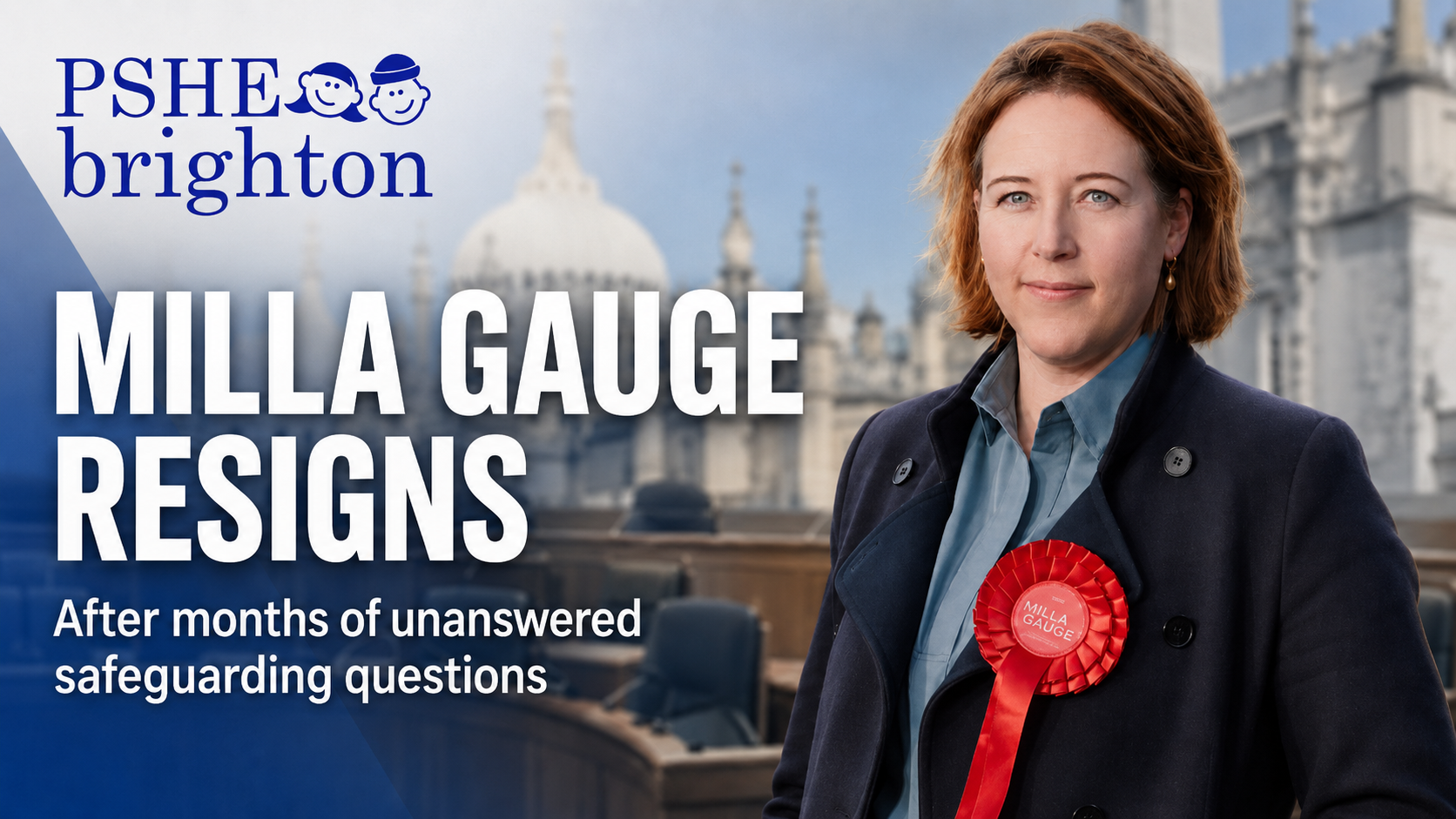
Milla Gauge’s resignation put safeguarding and accountability at the centre of the Queen’s Park by-election. PSHE Brighton’s questionnaire and candidates’ comments at the hustings reveal substantial differences over Council scrutiny, school safeguarding and political independence.
The Queen’s Park by-election on Thursday 24 September follows a resignation that left serious questions unanswered. As we reported in Milla Gauge Resigns After Months of Unanswered Safeguarding Questions, Gauge said she had repeatedly been prevented from pursuing residents’ concerns about child protection, gender-related policies and services for women. Her experience within Brighton & Hove City Council echoed the difficulties parents had encountered in seeking scrutiny from outside.¹ She resigned after concluding that she could no longer discharge those responsibilities effectively within the administration.²
Five candidates are standing to replace her: Dr Stefan Speckesser for the Conservatives, Mark Strong for the Greens, Steve Gladwin for Labour, Rüdiger (“Rüdi”) Dikty-Daudiyan for the Liberal Democrats, and John Shepherd for Reform UK.³ PSHE Brighton invited every candidate to answer the same seven questions, giving residents an opportunity to compare their positions on the concerns behind the election.
We sent out the questionnaire on 24 August under the heading Safeguarding, scrutiny and accountability, requesting answers of no more than 150 words per question by noon on Monday 14 September. We undertook to publish responses received, subject only to reasonable editing for length and clarity.⁴ We received substantive replies from Speckesser and Shepherd. Neither Gladwin nor Strong had responded at the time of writing, despite our efforts to contact their election agents by email and Special Delivery post. A hard copy was also handed to Gladwin personally at the hustings.
Our questions asked whether Gauge’s concerns warranted further scrutiny, whether the WellBN findings required examination of the Council’s own responsibilities, and whether candidates supported an independent safeguarding review. We also asked about professional curiosity, Equality Act compliance and councillors’ responsibility to identify risks without waiting for individual complaints. The final question concerned political independence: would candidates challenge their own political group when safeguarding, legal compliance or residents’ interests required it?⁴
These questions followed our correspondence with Chief Executive Jess Gibbons about the lessons the Council should draw from WellBN. We sought examination of school guidance, safeguarding arrangements, parental involvement and the handling of concerns across services. The request concerned the Council’s own responsibilities and the connections between services through which children and families had passed. An investigation confined to clinical treatment could not answer all those questions.⁵
Speckesser replied on 29 August and supported further scrutiny, a wider safeguarding investigation and an independent review extending to Council services and schools. “Yes, I support a wider review of council services and schools,” he wrote. He also supported a transparent audit of Council policies for Equality Act compliance and committed himself to identifying safeguarding risks proactively: “I will independently scrutinise council services and governance to catch systemic safeguarding risks before they cause harm.”⁶
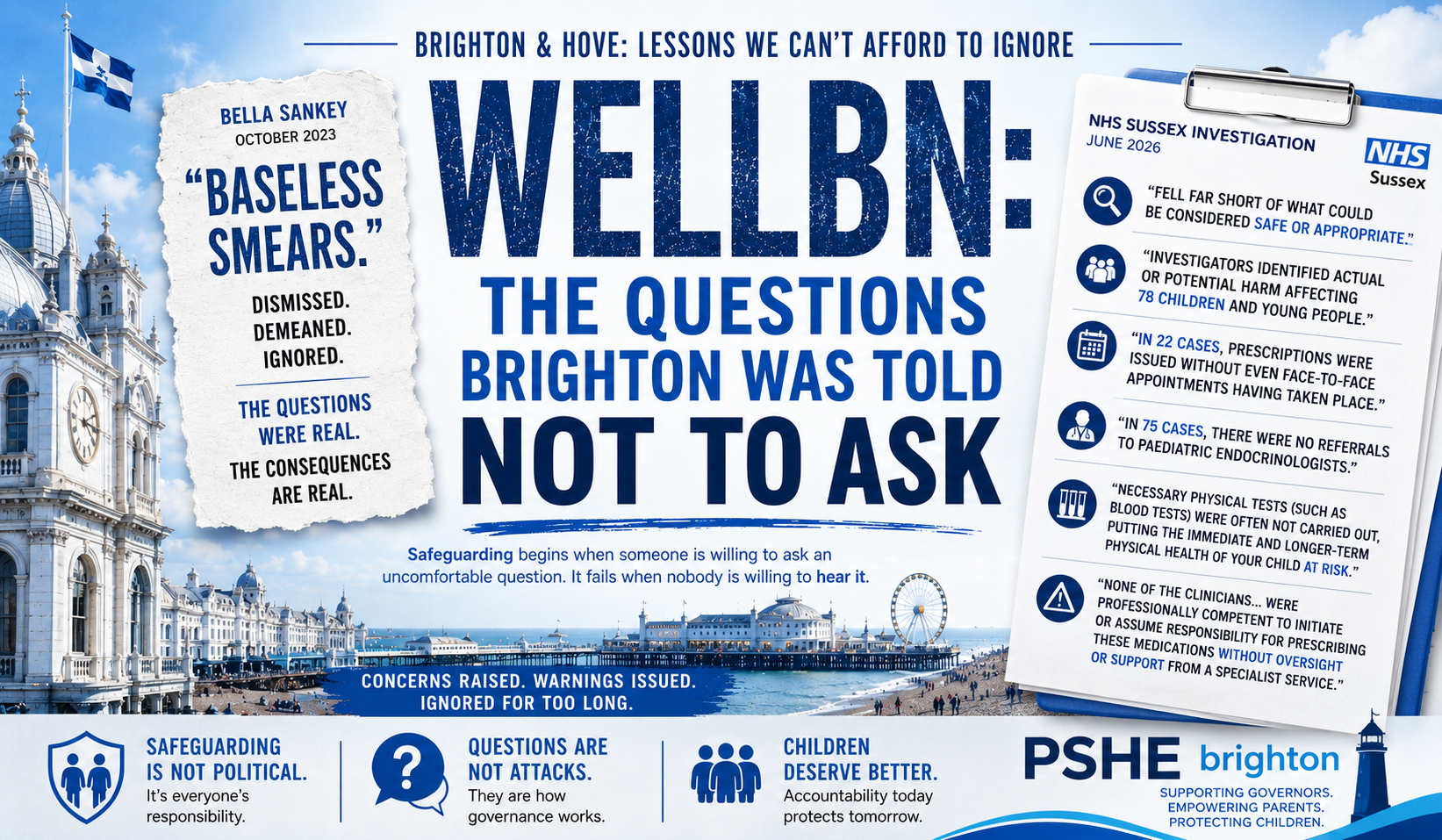
His response addressed matters already documented in our coverage and the press. In WellBN: The Questions Brighton Was Told Not to Ask, we reported the investigation’s identification of 78 children and young people who may have experienced actual or potential harm, alongside failures in assessment, consent, specialist referral and monitoring. The published NHS findings support concerns about inappropriate prescribing to children and young people.⁷ His call to examine school practices, social work involvement and external organisations also overlaps with concerns PSHE Brighton has raised about the connections between education, safeguarding and medical services.⁵ ⁸
Shepherd likewise supported further scrutiny and an independent review. “An independent safeguarding review is needed,” he wrote, adding that school guidance should be reviewed and the rights of women and girls recognised. He supported a wider examination of Council services and partnerships following WellBN and offered to work with Gauge on concerns brought to her while she was in office. His answer on councillors’ responsibilities accepted that they should act on matters affecting residents whether or not those matters had been raised with them personally.⁹ Both candidates therefore made substantive commitments in response to our questions.
The hustings at St Luke’s Church Hall on Thursday 17 September brought further differences into view. Organised by St Luke’s Residents’ Association, the event included questions about Gauge’s resignation, single-sex services and safeguarding scrutiny.¹⁰ Speckesser supported systematic examination of school safeguarding and an audit concerning single-sex provision. Shepherd criticised the treatment Gauge reportedly received and stressed parental involvement.¹¹
Gladwin defended the NHS investigation of WellBN and opposed the proposition that the Council’s Health Overview and Scrutiny Committee should have investigated that particular matter. He said: “But on this particular issue we need to give the NHS and the regulators the space to do so.” He also supported working with HOSC to establish whether further action was needed.¹¹ That leaves room for scrutiny, but does not specify its scope. Our questionnaire sought a clearer commitment: would he support examining the Council’s own policies, partnerships and handling of parental concerns, including an independent safeguarding review?
Strong compared the controversy to Section 28 and portrayed it as hostility towards transgender people. The newspaper reported his description of a “made up issue”, alongside his insistence that safeguarding should put children’s interests first.¹¹ Yet the questions before candidates arose from a councillor’s resignation, parents’ experiences and published NHS findings. Those specific matters require answers, whatever his assessment of the wider political debate. In his separate candidate interview, Strong highlighted his experience on a council scrutiny committee until July 2026.¹² Residents are entitled to ask how he would apply that experience to the concerns Gauge was unable to resolve.
Dikty-Daudiyan was absent from the hustings but supplied written answers for residents. He supported examining provision for women survivors of sexual violence and affirmed the importance of children’s safeguarding.¹¹ His statements at least acknowledge that the provision available to vulnerable residents merits examination.
The clearest difference between the written responses from Speckesser and Shepherd concerned Question 7. Speckesser answered directly: “I would not hesitate to confront my own or the Party’s position if constituent interests, the law, or community safety demanded it.” He concluded: “I will never compromise ethics or community safety for the sake of party politics.”⁶
Shepherd instead wrote: “If I am elected, I would – initially – be the sole Reform UK voice for family and community on the Council.” He then emphasised the difference one councillor could make and appealed for votes.⁹ In his newspaper interview, he promised: “As a Reform councillor, I will not be cowed from raising and scrutinising all issues of concern.”¹³ That is a commitment residents can hold him to, but it still leaves our particular question unanswered. Being his party’s only councillor would not preclude disagreement with its policies or leadership.
PSHE Brighton is a non-party-political group, and these commitments should be judged on their substance. Gauge’s resignation has made the practical test plain: when residents bring credible safeguarding concerns, will their councillor examine the evidence and pursue answers, including when colleagues would prefer the matter closed? Whoever wins on Thursday will inherit those unanswered questions. Residents should not have to begin again.
Milla Gauge has resigned from Brighton & Hove City Council after saying that she was repeatedly prevented from pursuing “urgent and credible” concerns about gender-distressed children, school policy, women’s services and equality law. Her account from inside the Labour administration closely corroborates what PSHEbrighton has encountered from outside: repeated attempts to secure a cross-system review of the implications of WellBN have been narrowed into separate complaints, diverted between procedures or dismissed on the ground that the Council has “no case to answer”.
Milla Gauge resigned as a Brighton & Hove councillor on the morning of 5 August. Her departure will trigger the eighth council by-election since the 2023 local elections. She is the eighth councillor elected for Labour to resign her seat and the third to do so in Queen’s Park; two other former Labour councillors have since left the party.¹
Those figures provide the political background, but they are not the reason her resignation matters to us.
Gauge says that she left after months of unsuccessful attempts to persuade the Council to examine concerns raised by residents about vulnerable children, school policies, external organisations, local health scrutiny and services for women who had experienced sexual violence. She says colleagues repeatedly told her that she must not pursue concerns which she regarded as both urgent and credible.
Her resignation statement is careful. It does not attack individual officers, councillors or transgender residents. It is written from the standpoint of safeguarding and public duty. Gauge refers to her career in the NHS, including work relating to violence against women and girls, as well as her experience as a school governor, charity trustee for vulnerable adults and magistrate. She is also a mother and stepmother to four daughters.
She writes that distressed children deserve compassionate, evidence-based care from practitioners working within their professional competence, and that families should be able to trust public bodies to ask difficult questions of themselves as well as of others. Safeguarding, she says, is “at the non-negotiable core” of that responsibility.
That conviction brought her into conflict with the administration of which she was a member.
What residents brought to her
Over two years, Gauge says that residents in Queen’s Park approached her with concerns which they felt were neither being heard nor answered. Parents questioned the Council’s approach to children experiencing gender-related distress, the role of external organisations in schools and the routes through which some vulnerable children came to be referred for medical intervention.
Women who had experienced sexual violence spoke to her about their safety, dignity and difficulty obtaining appropriate services. These residents were “not asking me to take sides in a culture war”, Gauge wrote. They wanted evidence to be sought and scrutinised, and public bodies to discharge their safeguarding responsibilities.
She attempted to act on those concerns through the means available to an elected member.
Gauge held private meetings, engaged with officers about data, raised matters within Labour group meetings and attempted to ask questions through committees and Full Council. She sought stronger protection for women and girls in licensing policy, greater recognition of their safety needs in the City Plan, improved whistleblowing arrangements through the Audit and Standards Committee, more rigorous use of Equality Impact Assessments through the People Overview and Scrutiny Committee, and accurate treatment of sex and gender data across Council services.
Her NHS employment meant that she could not participate directly in scrutiny of local health services. She therefore asked the Council leadership to commission a public review.
Following publication of NHS Sussex’s investigation into WellBN, she requested four particular measures: a public review of the Council’s scrutiny of gender-related health services; an urgent review of its guidance for schools; equivalent guidance recognising the rights and needs of girls; and an independent examination of Council policies for compliance with equality law.
These were defined and proportionate requests. They did not presume that the Council was responsible for clinical decisions made at WellBN. They asked whether serious findings involving local children should prompt examination of the Council’s own policies, safeguarding arrangements and scrutiny functions.
Gauge says that they did not.
When she followed up safeguarding concerns first raised publicly at her election hustings, she was told that they had not been repeated in private complaints and that there was therefore “no case to answer”. When she pursued stronger licensing protections for women and girls, she says that she was told not to communicate with officers or others about issues which were not confined solely to Queen’s Park, despite her membership of the Licensing Committee.
After the WellBN report, she was again told that the Council would make no public statement about its scrutiny of local health services because there was “no case to answer”.²
The phrase is revealing. A review is normally undertaken to establish whether there is a case requiring action. Here, the absence of an already established case appears to have been used as the reason not to examine the evidence from which one might emerge.
The same question from outside the Council
Gauge was aware of PSHEbrighton’s work. Our founders had occasionally approached her in the hope that she might be willing to listen and support proper scrutiny. Her resignation statement, however, is her own. It arises from her experience as a councillor and from concerns brought to her by residents.
That independence gives it particular weight.
We approached the Council from outside. Gauge pursued the issues from within. Both sought examination of substantially the same cross-system questions.
Neither claimed that Brighton & Hove City Council prescribed medication at WellBN. Neither asked the Council to assume responsibility for the clinical conduct of doctors. Both asked whether the NHS findings should lead the authority to examine the points at which education, safeguarding, SEND, autism, parental involvement, external organisations, healthcare, equality policy and local scrutiny meet.
The children concerned did not experience those systems separately. A vulnerable child might encounter school guidance, pastoral support, social transition, an external organisation and medical services as stages within one history. The Council’s departments and partner agencies may hold only fragments of that history. The question has always been whether anybody is willing and able to consider the whole.
Gauge says that she tried to do so from inside the Council and was obstructed. Our correspondence with Chief Executive Jess Gibbons provides contemporaneous evidence of the same institutional response from outside.
What we asked Jess Gibbons
On 1 July, more than one hundred residents wrote to the Chief Executive following publication of the WellBN investigation.
Our purpose was stated without ambiguity:
“The purpose of this letter is not to revisit the clinical findings themselves. Rather, it is to ask what lessons Brighton & Hove City Council intends to draw from them.”
We asked whether concerns raised by parents and residents over previous years had received appropriate scrutiny. We asked whether the Council would review its handling of social transition, parental involvement and safeguarding practice; whether Council-supported guidance and external organisations working with schools would be examined; how professional curiosity would be encouraged; and how parents could be assured that concerns challenging an established policy position would be treated fairly.
These were questions about corporate responsibility and institutional learning. They were not complaints against named adults, requests for the Council to investigate individual cases or attempts to transfer WellBN’s clinical responsibility to the local authority.³
Jess Gibbons replied on 6 July. She acknowledged concerns identified by the NHS investigation but emphasised that its remit had been confined to WellBN. She wrote:
“The investigation does not establish any connection between the matters identified and Council-run services.”
That was correct as a description of the investigation’s terms of reference. It did not address what we had asked.
The NHS report did not investigate the Council’s educational guidance, handling of parental concerns, external partnerships or local safeguarding culture. Its failure to make findings on those subjects cannot establish that no examination of them is required.
We were not asking whether NHS Sussex had already found the Council responsible. We were asking whether the Council was prepared to look.
The meeting that was recast as case management
On 16 July, we invited Jess Gibbons to meet privately with a small number of affected parents.
Again, the purpose was clear. The families’ experiences were not identical, but there were recurring themes: autism and other vulnerabilities, social transition within schools, communication with parents, referrals to outside organisations and eventual contact with NHS gender services.
We did not ask the Chief Executive to accept every account as fact or to investigate individual allegations during a private conversation. We asked her to hear enough of the families’ experiences to understand why the cumulative pattern might warrant a broader review.
The distinction was important because many of the families had already used individual complaints or safeguarding processes. Their concern was that each part of their experience had been separated from the rest. One school considered one incident; another service considered something else; a complaint was answered within its narrow terms; a health provider dealt only with the clinical element. The connections were lost.
Jess Gibbons’s first response nevertheless treated the proposed meeting as though it concerned allegations about adults working with children. She directed such concerns to the Local Authority Designated Officer.
The LADO has a defined and necessary role in considering allegations concerning adults who work with children. It was not the subject of our request.
We replied and clarified that the proposed meeting concerned recurring and potentially systemic matters: Council policy, school practice, safeguarding culture, social transition, parental communication, external referrals and the handling of complaints. We were not asking the Chief Executive to replace the LADO or adjudicate allegations against individuals.
Her subsequent reply expressly acknowledged the distinction:
“I note the distinction you draw between concerns relating to the conduct of individual adults and wider concerns regarding safeguarding arrangements, policy and governance.”
The possibility of an innocent misunderstanding had therefore been removed. The Chief Executive understood that we were asking to discuss wider institutional questions.
She still refused to meet.
Her reply continued to describe the proposed meeting as a route for “raising or investigating” matters, although no such private investigation had been requested. She referred us instead to the Council’s “established safeguarding, complaints and governance arrangements”, without identifying which particular process could examine evidence from several families collectively, reconsider earlier complaints handling, assess the interaction between school policy and health pathways or recommend an independent corporate review.⁴
Read as a sequence, the correspondence gives the appearance of procedural evasion. A clearly systemic request was first reframed as an allegation-management issue. Once that framing was corrected and the distinction acknowledged, the same request was redirected into unspecified procedures organised around separate functions and individual cases.
Whatever the intention, the effect was to prevent the Council’s most senior officer from hearing the cross-system question we had put to her.
Gauge tried the procedures to which we were directed
This is where Milla Gauge’s resignation becomes more than a parallel story.
The Chief Executive assured us that established safeguarding, complaints and governance arrangements were the proper means through which concerns about policy, practice and institutional learning could be examined.
Gauge says that she used those arrangements.
She spoke to officers and examined data. She raised the issues within the governing Labour group. She attempted to use committees and Full Council. She worked through Audit and Standards, People Overview and Scrutiny, licensing and planning. She asked the leadership for specific reviews of health scrutiny, school guidance, the position of girls and compliance with equality law.
Her access to the Council’s internal machinery was considerably greater than that of any parent making a complaint. Yet she says that she was still prevented from pursuing the issues and repeatedly told that there was no case to answer.
The problem was not, then, that residents had selected the wrong procedural route. An elected councillor tried several routes over many months and reached the same obstruction.
Gauge’s account supports our concern that Brighton & Hove’s arrangements may be capable of distributing individual matters between departments while remaining unable—or unwilling—to examine what those matters disclose when brought together.
WellBN and the Council’s scrutiny role
NHS Sussex’s investigation into WellBN identified 78 children and young people who may have experienced actual or potential harm. The published findings included prescriptions issued without a face-to-face consultation in 22 cases, no referral to a paediatric endocrinologist in 75 cases, inadequate physical monitoring and serious deficiencies in assessment, consent, record-keeping and clinical competence. Children as young as eleven were within the group reviewed.⁵
No responsible account of these findings should blur institutional responsibility. WellBN practitioners made the clinical decisions. NHS Sussex conducted the patient-safety investigation. Brighton & Hove City Council did neither.
The Council does, however, participate in local safeguarding arrangements and possesses statutory functions for reviewing and scrutinising matters relating to the planning, provision and operation of health services in its area. Those functions exist so that local councillors can represent residents, test information and hold health providers and NHS bodies to account.⁶
Gauge did not claim that Brighton & Hove caused WellBN’s failures. She argued that the report, alongside concerns already raised with the Council, should have prompted open reflection on whether local health scrutiny, safeguarding between services and sex- and gender-related policies had been sufficiently robust.
That is also what we have asked.
The proper answer cannot be that the clinical failures happened elsewhere. Organisational learning often begins with an incident for which another body had immediate responsibility. The question is whether warning signs were missed, whether information failed to travel, whether shared assumptions discouraged challenge and whether related Council policies now require review.
The Health and Wellbeing Board
We took these questions to Brighton & Hove’s Health and Wellbeing Board on 28 July.
Our deputation asked whether the Council had considered what lessons the WellBN investigation might hold for its own safeguarding arrangements. We also asked whether a review had been undertaken and, if not, whether the board would commission one.
We were explicit that we were not attributing WellBN’s clinical failures to the Council. We asked for the principles expected after any serious safeguarding event: curiosity, transparency, partnership working and organisational learning.
The board did not answer the two questions. Its chair, Councillor Paul Nann, said that the Health Overview and Scrutiny Committee was the correct forum.
A possible route has therefore been identified. A founder of PSHEbrighton subsequently noted that HOSC had indicated that it would consider undertaking scrutiny. That is welcome, but no defined scope, timetable or formal commitment has yet been published in the material available to us.⁷
Gauge’s resignation makes that uncertainty more pressing. She says that she had already asked the Council leadership for a public review of its scrutiny of gender-related health services and could not secure one.
If HOSC is now prepared to consider the matter, it should say so publicly, define the questions it proposes to examine and establish when the scrutiny will occur.
The data breach and the reliability of the “established routes”
The deputation also produced an incident which cannot be ignored when residents are told to trust established Council processes.
The papers published on 24 July included the full names and home addresses of our deputation’s speaker and five supporters. The Council would normally publish their names, not their addresses.
Those affected contacted senior officers, the Chief Executive, Council leader Bella Sankey and the Council’s out-of-hours arrangements. The document remained online for about twenty hours. Some supporters had previously received threats; one was installing CCTV at home.
The Council subsequently apologised, informed its data-protection officer, required officers to repeat information-governance training and said that procedures had been changed to prevent a recurrence. There is no published evidence that the disclosure was deliberate. It was nonetheless a serious governance failure with possible consequences for residents’ safety.⁸
Its relevance is practical. Families considering whether to submit further detailed material about vulnerable children, schools, medical treatment and ongoing complaints are entitled to ask who will see it, how it will be stored and whether it may be disclosed.
The breach occurred while residents were using one of the formal democratic procedures to which they are routinely directed. It is therefore not enough to assure us that established processes are necessarily structured, confidential and accountable. Those claims must be demonstrated.
The Council’s response to the breach also provides a useful contrast. Once the failure was acknowledged, it apologised, notified the appropriate officer, arranged further training and altered the process. It did not claim that the error belonged to one team and could teach the wider authority nothing.
That is the form of organisational learning we have requested following WellBN.
School guidance, girls and the new legal position
Gauge also asked for an urgent review of Brighton & Hove’s guidance for schools, equivalent guidance recognising the rights and needs of girls, and an independent audit of Council policies for compliance with equality law.
These requests were not incidental to WellBN.
The Council has promoted guidance covering social transition, names and pronouns, confidentiality, records, toilets, changing facilities, sport, curriculum content and external organisations. Schools do not prescribe hormones, but they can influence how a child’s distress is understood, whether a social transition is facilitated, how parents are involved and which outside services are recommended.
This does not establish a simple causal chain between Council guidance and the WellBN findings. It does make a review of the wider pathway reasonable.
Gauge’s concern for girls and women was also grounded in evidence brought to her by survivors of sexual violence. She sought better recognition of their privacy, dignity and need for appropriate services. That was not presented as hostility towards transgender residents. Her stated position was fair treatment for all, alongside safeguarding for those who are vulnerable.
She resigned on the day the updated EHRC Code of Practice for Services, Public Functions and Associations came into force. The Code is statutory guidance intended to help public bodies and service providers understand and comply with the Equality Act 2010. Relevant provisions are admissible in criminal or civil proceedings, and courts and tribunals must take into account those which appear relevant to the questions before them.⁹
The Code follows the Supreme Court’s clarification that references to sex, man and woman in the Equality Act concern biological sex, while the separate protection against discrimination because of gender reassignment remains in place.¹⁰
Gauge says that she repeatedly asked the Council for assurance that it would comply with the clarified legal position and explain publicly how and when that would happen. She had received no such assurance when she resigned.
The questions the Council must now answer
Milla Gauge’s resignation does not establish that every concern raised by a parent, resident or campaign group will ultimately be upheld. It establishes something the Council can no longer dismiss as an external misunderstanding.
A member of the governing Labour group, with substantial professional and civic experience, says that she spent months using the Council’s internal procedures to seek scrutiny of the same cross-system concerns we have raised. She could not obtain it.
We asked the Chief Executive to hear affected families because their separate histories appeared to expose recurring problems across schools, safeguarding, SEND, external organisations, health services and Council policy. Our request was clear. It was initially misdirected to the LADO, then expressly understood, declined and returned to unnamed procedures.
Gauge says that she used those procedures from inside and was still told there was no case to answer.
Brighton & Hove City Council should now state whether HOSC will examine its scrutiny of WellBN and related gender services; whether its school guidance and associated materials are under formal review; how it will implement the EHRC Code; what equivalent consideration it is giving to the needs of girls and women; and which process can examine evidence from several families as a possible institutional pattern rather than a collection of unrelated complaints.
The Chief Executive should also reconsider her refusal to hear the parents. The invitation was never to investigate private cases. It was to understand what the individual cases, considered together, may say about the system.
Milla Gauge has now resigned because she concluded that she could not pursue those questions effectively from within the administration.
They cannot credibly be sent around the Council once again.
1. Jo Wadsworth, ‘Labour councillor quits, saying council is failing kids on trans issues’, Brighton and Hove News, 5 August 2026, incorporating Milla Gauge’s resignation statement. brightonandhovenews.org/2026/08/05/labour-councillor-quits-saying-council-is-failing-kids-on-trans-issues/ 2. Wadsworth, ‘Labour councillor quits’. 3. PSHEbrighton, ‘Parents ask Council Chief Executive what lessons have been learned from the WellBN investigation’, 21 July 2026, reproducing the letter from more than one hundred Brighton & Hove residents to Jess Gibbons, 1 July 2026, and the Chief Executive’s reply of 6 July 2026. pshebrighton.org/pshebrighton/parents-bhcc-ceo-letter/ 4. Email correspondence between PSHEbrighton and Jess Gibbons, Chief Executive of Brighton & Hove City Council: PSHEbrighton’s invitation to meet affected parents, 16 July 2026; Gibbons’s reply referring concerns to the Local Authority Designated Officer; PSHEbrighton’s clarification of the systemic and governance issues; and Gibbons’s further reply declining the meeting, 5 August 2026. Copies held by PSHEbrighton. 5. NHS Sussex, Patient Safety Investigation into Gender-Related Prescribing at WellBN, 2026; see also PSHEbrighton, ‘WellBN: The Questions Brighton Was Told Not to Ask’, 12 June 2026. pshebrighton.org/in-the-news/wellbn-the-questions-brighton-was-told-not-to-ask/ 6. Department of Health and Social Care, ‘Local authority health scrutiny’, updated 9 January 2024, especially the sections concerning the purpose, scope and discharge of health-scrutiny functions; The Local Authority (Public Health, Health and Wellbeing Boards and Health Scrutiny) Regulations 2013, SI 2013/218. gov.uk/government/publications/advice-to-local-authorities-on-scrutinising-health-services/local-authority-health-scrutiny legislation.gov.uk/uksi/2013/218/contents/made 7. Sarah Booker-Lewis, ‘Campaigners alarmed by online data breach’, Brighton and Hove News, 4 August 2026, including the Council’s response and Adrian Hart’s subsequent comment concerning possible consideration of scrutiny by the Health Overview and Scrutiny Committee. brightonandhovenews.org/2026/08/04/campaigners-alarmed-by-online-data-breach/ 8. Booker-Lewis, ‘Campaigners alarmed by online data breach’. 9. Office for Equality and Opportunity and Equality and Human Rights Commission, Equality Act 2010: Code of Practice for Services, Public Functions and Associations 2026 (London, 2026), ISBN 978-1-5286-6395-3, in force from 5 August 2026; Equality Act 2006, ss. 14–15; The Equality Act 2010 (Code of Practice on Services, Public Functions and Associations) Order 2026, SI 2026/788. gov.uk/government/publications/equality-act-2010-code-of-practice-for-services-public-functions-and-associations-2026 legislation.gov.uk/uksi/2026/788/made 10.For Women Scotland Ltd v The Scottish Ministers [2025] UKSC 16, judgment and press summary, 16 April 2025. supremecourt.uk/cases/uksc-2024-0042
A revealing Full Council exchange combined genuine personal distress with serious confusion about the legal position. Brighton & Hove City Council may campaign to change the law, but it must implement the law that exists, consult impartially across protected groups and explain how its policies will comply when the new statutory Code takes effect on 5 August.
A second exchange at Brighton & Hove City Council has raised substantial questions about legal compliance, institutional neutrality and the authority’s readiness for the updated Equality and Human Rights Commission Code of Practice.
Councillor Raphael Hill asked how the Council intended to respond to the new Code of Practice for Services, Public Functions and Associations, which comes into force on 5 August 2026.
His question began from a highly critical assessment of the Code:
“This guidance appears to conflict with the Public Sector Equality Duty and other equality legislation, and therefore seems unworkable.”
He asked how the Council would navigate that supposed uncertainty while upholding the dignity of transgender people, which he said the guidance undermined.
Councillor Mitchie Alexander replied that the Supreme Court judgment had had:
“a very negative effect on our trans and non-binary communities, and also on people who have a gender non-conforming appearance.”
She confirmed that Brighton & Hove would remain both a “trans-inclusive employer” and a “trans-inclusive Council”, while adding that the authority would also comply with the law.
Councillor Alexander said the Council was meeting transgender, non-binary and intersex representatives through its TNBI Roundtable to understand their concerns and consider how the Council might “mitigate some of the harms currently being felt”.
She then made the political administration’s position unusually explicit:
“We also believe that the guidance is flawed and confusing, and we will continue pressing the Government to legislate to ensure that the dignity of trans people is protected.”
The supplementary exchange became more personal.
Councillor Hill asked:
“What would you say to transgender people like myself who feel that this Government treats us as a disease, unwelcome in society?”
He continued:
“Why should we trust a Government that endorses guidance which treats us as sexual predators simply for existing as who we are?”
Councillor Alexander responded sympathetically but without correcting the legal premise:
“To be honest, I don’t really know how to answer you, except to say that I am very sorry.”
She said that she was trying to understand the pain being experienced by transgender and non-binary people, that a Council team was working on the issues, and that she hoped to offer a clearer answer “in a couple of months’ time”.
The distress expressed in the chamber was plainly genuine. It deserved a humane response.
What it did not receive was a legally clear one.
Political disagreement is not legal uncertainty
The central premise of the question was that different parts of equality law now point in contradictory directions.
They do not.
The Supreme Court held unanimously in For Women Scotland Ltd v Scottish Ministers that the words “man”, “woman” and “sex” in the Equality Act 2010 refer to biological sex. The judgment also made clear that transgender people remain protected against discrimination under the separate protected characteristic of gender reassignment.
The updated EHRC Code does not compete with the Equality Act, nor does it displace the Public Sector Equality Duty. It is a statutory Code designed to explain how the Act applies to services, public functions and associations following legal developments, including the Supreme Court’s judgment. The Code itself states that it has been formally approved and laid before Parliament.
The commencement regulations were made on 14 July 2026. They provide that the new Code comes into force on 5 August 2026.
Brighton & Hove councillors are entitled to believe that Parliament should change the law. They are entitled to campaign for that outcome and to criticise the judgment or the Code politically.
The Council, as a public authority, must meanwhile apply the law that exists.
Disagreement with the law does not make the law internally contradictory. Nor does describing statutory guidance as “confusing” suspend the Council’s obligation to understand and implement it accurately.
The Code does not describe transgender people as predators
Councillor Hill’s supplementary question conveyed profound personal pain. That should neither be mocked nor trivialised.
It is entirely possible for legal change, public debate and political rhetoric to leave people feeling rejected or afraid. A responsible Council should listen carefully to residents and employees who describe such effects.
Compassion must nevertheless be accompanied by accuracy.
Neither the Supreme Court judgment nor the statutory Code declares transgender people to be diseased, predatory or unwelcome. The Code continues to recognise gender reassignment as a protected characteristic, alongside sex, disability, race, religion or belief, sexual orientation and the other characteristics within its scope.
The Code addresses the legal circumstances in which services may be provided separately or exclusively according to sex. Those circumstances may involve privacy, dignity, intimate care, safety, trauma or the nature of the service being provided.
A female-only refuge, changing facility, ward or intimate-care service does not assert that every male person is a predator. Sex separation can serve legitimate needs without imputing criminal intent to anyone excluded from that provision.
Councillor Alexander could therefore have acknowledged her colleague’s distress while also stating clearly that the law does not characterise transgender people in the way suggested.
Instead, the accusation was met only with apology.
That may have been emotionally understandable, but it was institutionally unhelpful. By failing to correct an inaccurate description of the Code, the response risked reinforcing fear rather than explaining the legal position.
“We believe the guidance is flawed and confusing”
The most important statement in the exchange was Councillor Alexander’s assertion:
“We also believe that the guidance is flawed and confusing.”
The word “we” requires clarification.
Does this represent a formally adopted position of Brighton & Hove City Council? Is it the view of the political administration, the Labour group, the Cabinet, a working group or Councillor Alexander personally?
Was the conclusion reached after advice from the Monitoring Officer or specialist equality lawyers? Has the Council identified particular provisions which it considers unclear? Has an equality impact assessment been completed?
None of this was explained.
That omission matters because political opposition and lawful administration are different functions.
Councillors may campaign against the Code. Council officers must implement it impartially.
A public authority cannot begin a statutory compliance exercise with the settled aim of neutralising provisions its political leadership regards as harmful. Nor can it use a broad commitment to “inclusion” to preserve practices which no longer reflect the legal meaning of sex.
Where the administration publicly characterises the Code as flawed before publishing its legal analysis or implementation plan, residents are entitled to ask whether the forthcoming review will be genuinely open-minded.
The Public Sector Equality Duty does not override the Code
Councillor Hill suggested that the Code appeared to conflict with the Public Sector Equality Duty.
That misunderstands the relationship between them.
The Public Sector Equality Duty is contained in section 149 of the Equality Act 2010. It requires public authorities to have due regard to the need to eliminate unlawful discrimination, advance equality of opportunity and foster good relations.
It applies across protected characteristics. It does not authorise a Council to prefer one politically favoured interpretation of equality over the meaning of the statute established by the Supreme Court.
The Government’s equality impact assessment explains that the purpose of the updated Code is to clarify the law and facilitate compliance with the Equality Act.
For Brighton & Hove, proper compliance means considering the effects of policy upon transgender people. It also means considering women and girls, disabled residents, survivors of sexual or domestic violence, people receiving intimate care, religious communities, employees and those holding protected gender-critical beliefs.
The duty requires evidence and serious consideration of competing impacts.
It does not operate as an escape clause from statutory guidance.
The TNBI Roundtable is relevant, but it is not the whole equality exercise
Councillor Alexander said that the Council was meeting regularly with transgender, non-binary and intersex representatives through its TNBI Roundtable.
That is a legitimate and potentially valuable part of the Council’s work.
People directly affected by policies should be heard. The Council should understand where transgender residents or employees fear humiliation, exclusion or discriminatory treatment.
The difficulty arises if this is presented as the principal or only consultation relevant to implementation.
The new Code concerns legal duties affecting a range of groups whose needs may intersect or conflict. Women using refuges or communal facilities, disabled people requiring intimate assistance, survivors of sexual violence, Council employees, service managers, faith communities and those with protected philosophical beliefs may all be affected.
An impartial process should therefore include them.
This does not mean treating transgender residents as less deserving of consultation. It means recognising that equality governance cannot consist of hearing one constituency and then deciding how to “mitigate” the lawful effects of guidance upon that group.
The Council’s task is to understand the consequences for all relevant protected characteristics and to make proportionate decisions within the law.
“Trans-inclusive” must be translated into lawful practice
Councillor Alexander repeatedly promised that Brighton & Hove would remain a “trans-inclusive Council”.
That phrase may describe a proper commitment. It may mean protecting transgender residents and employees from harassment and unlawful discrimination, treating people with courtesy, ensuring access to public services and providing appropriate alternative arrangements where necessary.
All of that may be consistent with the new Code.
The phrase becomes problematic if it means that self-declared gender identity will continue to determine a person’s sex for every legal and administrative purpose.
That position would not be compatible with the Supreme Court judgment.
The Council must therefore explain what “trans-inclusive” means operationally.
How will public records distinguish sex and gender reassignment where both are relevant?
How will lawful single-sex services operate?
How will transgender people be protected from unlawful discrimination?
What alternative provision will be considered where a person cannot access a service restricted by sex?
How will employees be trained to avoid both unlawful exclusion and unlawful erosion of sex-based provision?
A value statement is not an implementation plan.
The Council has not been taken by surprise
Councillor Alexander said:
“There is a team within the Council working on these issues.”
She then added:
“I hope that in a couple of months’ time I will be able to stand here and answer more clearly.”
The timetable makes that answer difficult to defend.
The Supreme Court delivered judgment in April 2025. The updated Code was laid before Parliament on 21 May 2026. The commencement regulations were made on 14 July. The Code takes effect on 5 August.
The Council has therefore had extensive notice that legal and policy review would be required.
By the time of the Full Council exchange, commencement was not a distant possibility. It was imminent.
The Council should already be able to identify which policies and services are being reviewed, which officer is accountable, what legal principles are being applied, how staff are being trained and what arrangements will operate from 5 August.
Saying that a team is working on the problem provides almost no public accountability.
Promising clarity “in a couple of months” means promising it after the Code has already entered into force.
The most striking omission: no mention of women
One feature of the exchange was particularly revealing.
There was repeated reference to the effect of the judgment and Code upon transgender and non-binary people. There was reference to the TNBI Roundtable, trans inclusion, pain and harm.
There was no comparable acknowledgment of why sex-based provisions exist or of the people whose rights and needs they protect.
Women and girls were absent from the answer.
So were survivors of sexual violence, users of female-only services, disabled women requiring intimate care, religious women and others for whom sex-based privacy may be important.
That imbalance matters.
The Code was not produced merely to impose restrictions upon transgender people. It clarifies how the Equality Act protects sex as well as gender reassignment and how institutions should apply lawful exceptions relating to separate and single-sex services.
A Council undertaking equality analysis must begin with all relevant protected groups in view.
The language of “mitigating harms” to one constituency, without any corresponding recognition of the rights or needs of another, suggests that the authority may be approaching the issue from a predetermined hierarchy of concern.
Emotion became a substitute for governance
The supplementary response was compassionate but strikingly empty of administrative content.
Councillor Alexander said she was sorry. She recognised pain. She said the situation was difficult. She referred to a team working on the matter and hoped to know more later.
None of those statements answered how the Council would comply.
No policy review was identified.
No implementation timetable was given.
No legal framework was explained.
No responsible officer was named.
No consultation beyond the TNBI Roundtable was described.
No distinction was drawn between political campaigning and administrative duty.
This is not a criticism of empathy. Empathy is necessary in public life.
The problem arises when empathy is used in place of governance, especially where the question concerns the imminent commencement of statutory guidance.
Councillor Hill asked why transgender people should trust the Government. Councillor Alexander answered as a sympathetic political colleague.
The Council also needed an answer from someone exercising responsibility for a public authority.
It did not receive one.
The wider institutional pattern
This exchange should be read alongside the earlier Full Council discussion concerning SEND, WellBN and parental safeguarding concerns.
In that exchange, the Council was asked what had changed to ensure that concerns about vulnerable children would be approached with professional curiosity.
The answer identified no change. It stated that the Council had not operated WellBN and expressed confidence in existing governance.
Here, the Council was asked how it would implement a new statutory Code.
Again, the answer was primarily declaratory.
The Council would remain trans-inclusive.
The guidance was flawed and confusing.
A team was working on it.
A fuller answer might come later.
Taken together, the exchanges suggest a recurring institutional habit. When evidence or law challenges an established position, the Council begins by defending its identity and values rather than explaining what it has reviewed, learned or changed.
That is a governance problem.
Confidence is not evidence.
Compassion is not implementation.
Political principle is not legal advice.
The relevance to the Council’s wider policies
The updated Code concerns services, public functions and associations. Separate statutory and technical frameworks govern schools.
The Council’s public position nevertheless matters beyond the immediate services covered by this Code.
Brighton & Hove has historically embedded concepts of transgender inclusion across employment, public services, safeguarding and education. It has promoted a Trans Inclusion Schools Toolkit and related curriculum approaches which must now be reviewed alongside the Supreme Court judgment, Keeping Children Safe in Education 2026, revised statutory RSHE guidance and the developing EHRC guidance for schools.
The Full Council exchange raises a legitimate concern about the spirit in which those reviews will be conducted.
Will the authority ask neutrally what the law and evidence now require?
Or will it begin from the political assumption that the new framework is harmful and seek to retain as much of the previous approach as possible?
Parents, governors, employees and residents are entitled to know.
What the Council should publish
Brighton & Hove City Council should publish an implementation statement before 5 August.
It should identify the services, public functions, workplace policies and facilities under review.
It should name the senior officer accountable for compliance and provide the implementation timetable.
It should explain how the Council understands the legal distinction between sex and gender reassignment.
It should set out how transgender people will continue to be protected from unlawful discrimination and how lawful single-sex services will be maintained.
It should identify the range of affected groups being consulted, rather than referring only to the TNBI Roundtable.
It should clarify whether the description of the Code as “flawed and confusing” is official Council policy, the political administration’s position or an individual councillor’s view.
It should also explain what “trans-inclusive Council” means in concrete legal and operational terms.
The Council need not publish privileged legal advice. It can and should publish the principles it intends to apply and the practical decisions arising from them.
Dignity and legality are not opposites
The exchange repeatedly implied that recognising biological sex under the Equality Act and treating transgender people with dignity are incompatible aims.
They are not.
A Council can recognise sex where the law requires it and still treat transgender residents with humanity.
It can preserve lawful single-sex services without alleging that transgender people are predators.
It can provide appropriate alternatives without humiliating those who use them.
It can protect transgender employees from harassment while respecting the lawful rights, privacy and beliefs of others.
It can acknowledge Councillor Hill’s pain without endorsing an inaccurate description of the judgment or Code.
It can campaign democratically for Parliament to amend the law while obeying the law now in force.
The task is not to choose between legality and dignity.
It is to uphold both.
At Full Council, the public heard that the Code was “flawed and confusing”, that the Council would remain trans-inclusive, that a team was working on the issue and that a clearer answer might be available in several months.
The Code takes effect on 5 August.
Brighton & Hove residents deserve that clearer answer before then.
1. UK Supreme Court, For Women Scotland Ltd v Scottish Ministers, judgment and press summary, 16 April 2025. 2. Equality and Human Rights Commission, Code of Practice for Services, Public Functions and Associations 2026, particularly Chapter 1 on the status and purpose of the statutory Code. 3.The Equality Act 2010 (Code of Practice on Services, Public Functions and Associations) Order 2026, SI 2026/788, made 14 July 2026 and coming into force on 5 August 2026. 4. Equality Act 2010, Schedule 3; EHRC, Code of Practice for Services, Public Functions and Associations 2026, provisions concerning separate and single-sex services. 5. Equality Act 2010, sections 7, 13, 19, 26 and 27; EHRC, Code of Practice for Services, Public Functions and Associations 2026, chapters concerning protected characteristics, discrimination, harassment and victimisation. 6. Equality Act 2010, section 149; Office for Equality and Opportunity, Equality Impact Assessment: Equality Act 2010 Code of Practice for Services, Public Functions and Associations 2026, revised 15 July 2026. 7. Brighton & Hove City Council Full Council meeting, public question and supplementary exchange between Councillors Raphael Hill and Mitchie Alexander, 23 July 2026; official meeting recording supplied by the Council.
A public question about autism, Special Educational Needs and Disabilities, and parental safeguarding concerns produced a careful first response and a markedly defensive second. The exchange matters because, when asked what Brighton & Hove City Council had changed in response to serious local concerns, the Council identified no change at all.
A recent exchange at Brighton & Hove City Council has placed an important safeguarding question on the public record.
Kate Sawyer asked Councillor Emma Daniel how the lessons arising from the failures of the Tavistock Gender Identity Development Service had informed the Council’s SEND Reform Plan.
SEND means Special Educational Needs and Disabilities. The term covers children and young people who require additional educational provision because they have learning difficulties, disabilities, neurodevelopmental conditions or other needs that make it harder for them to access education on the same basis as their peers. Autism falls within this framework, although not every autistic child has identical educational needs.
Kate’s question was particularly concerned with the recognised vulnerability of autistic children experiencing gender-related distress. She asked how those lessons had informed the Council’s SEND strategy, workforce training and its “Experts at Hand” model.
The question was carefully framed. It did not ask the Council to assume responsibility for NHS clinical services. It asked whether national lessons concerning autism, safeguarding and gender-related distress had influenced the Council’s own educational planning.
Councillor Daniel’s first answer was more considered than might have been expected. She acknowledged that the Cass Review had examined the needs of autistic young people within gender services, while arguing that it was not directly concerned with the wider delivery of SEND support in education.
She also spoke about the historic under-identification of autism in girls, the need for holistic support and the Council’s employment of specialist teachers in autism and wider neurodivergence through the “Experts at Hand” programme.
There were points of substance in that answer. There was also a clear attempt to confine the relevance of Cass to healthcare.
Kate Sawyer’s supplementary question exposed the weakness of that distinction.
A question about governance, not clinical responsibility
Kate asked:
“What has changed within the Council to ensure that when parents raise safeguarding concerns about vulnerable children, those concerns are treated with professional curiosity as potential evidence requiring exploration, rather than being dismissed before they have been properly examined?”
This was not a question about who operated WellBN.
It was not a request for Brighton & Hove City Council to account for prescribing decisions.
It was a question about the Council’s own safeguarding culture: how it receives parental concerns, how those concerns are assessed and whether anything has changed.
Councillor Daniel replied:
“The Council did not run the WellBN service, nor do I see that as in any way relevant to our SEND Reform Plan.”
She then said that she was confident in the Council’s safeguarding governance, complaints procedures and the external validation of those procedures.
That response did not identify a single change.
The distinction between NHS and Council responsibilities is legally important, but it does not answer the question asked. Kate did not suggest that the Council ran WellBN. She asked whether serious failures identified within one part of the local safeguarding environment had prompted reflection within another.
An adequate answer might have identified revised guidance, improved recording of parental concerns, additional training, new escalation procedures, changes to professional supervision, independent review or strengthened parental engagement.
None was offered.
The answer was confidence.
The first response acknowledged more than it may have intended
Councillor Daniel’s initial answer contained several important acknowledgements.
She accepted that the Cass Review considered the needs of autistic young people. She referred to the historic overlooking of autism in girls. She endorsed holistic support and recognised that failures or barriers within health services can affect a child’s education.
Each of those points supports the premise underlying Kate’s question: autism, gender-related distress, health provision and education may intersect in ways that demand particular safeguarding attention.
The discussion of autistic girls was especially significant.
Girls whose autism is missed or recognised late may present with anxiety, social difficulties, distress, eating problems, identity confusion or other complex needs before their underlying neurodevelopmental profile is properly understood. The importance of early identification and specialist support is therefore not confined to general SEND provision. It is directly relevant whenever a vulnerable child’s distress is being interpreted and acted upon.
The Council’s SEND Reform Plan may properly focus upon education. That does not make the lessons arising from failures in gender services irrelevant to the assessment and safeguarding of autistic children.
A genuinely holistic approach should make those lessons more relevant, not less.
Narrowing Cass to avoid its wider implications
Councillor Daniel described Cass primarily as a review of specific health services and medical interventions.
That description is not false, but it is incomplete.
The significance of the Cass Review extends beyond the internal organisation of specialist clinics. It raised wider questions about the quality of evidence, safeguarding, neurodevelopmental vulnerability, diagnostic overshadowing, parental involvement, social transition and the danger of interpreting complex distress through a single explanatory framework.
Those questions do not cease to matter when a child leaves a clinic and enters a school.
Schools do not diagnose gender dysphoria or prescribe medication. They may, however, become involved in identifying distress, facilitating social transition, changing names or pronouns, communicating with parents, referring families to external organisations and deciding how a child’s expressed identity is handled in school life.
A local authority that supports SEND provision, produces educational guidance, trains staff and participates in local safeguarding arrangements cannot reasonably treat these wider lessons as belonging exclusively to the NHS.
The issue is not whether the Cass Review dictated the contents of Brighton & Hove’s SEND Reform Plan.
The issue is whether its safeguarding lessons were consciously considered.
The Council’s answer did not establish that they were.
“Holistic” must mean examining the whole child
Councillor Daniel said that schools should take a holistic approach to children, including young people who identify as trans or believe they may be trans.
That principle is sound.
A holistic approach, however, must mean more than accommodating an expressed identity on a case-by-case basis. It requires professionals to consider the whole child: developmental history, autism, mental health, family relationships, trauma, peer influence, online activity, social pressures and the possible effects of actions taken by adults.
It also requires professional curiosity.
Professional curiosity means resisting premature certainty. It means asking whether the first explanation offered is sufficient, whether relevant information has been overlooked and whether parents or other professionals hold evidence capable of changing the safeguarding picture.
It means recognising that affirmation is not the same as assessment, and that kindness does not require adults to suspend judgement.
Kate Sawyer’s supplementary question asked how the Council ensures that concerns are explored rather than dismissed.
No process was described.
No change was identified.
No example was given.
Personal experience cannot answer an institutional question
Councillor Daniel referred to her own experience as the parent of an autistic daughter.
That experience is relevant and deserves respect. It may provide genuine insight into the difficulties faced by autistic girls and their families.
It does not, however, answer an institutional governance question.
The issue was not whether an individual councillor understands autism. It was whether Brighton & Hove City Council had examined how parental safeguarding concerns are received, recorded, assessed, escalated and scrutinised.
Personal credibility cannot substitute for institutional evidence.
Indeed, invoking personal experience risks moving the discussion away from the question that was actually asked. The issue is not whether one councillor has overlooked autism in girls. It is whether the Council’s structures have overlooked, misunderstood or dismissed parental evidence concerning vulnerable children.
That required an institutional answer.
It did not receive one.
Confidence is not evidence
Councillor Daniel said that she was confident in the Council’s safeguarding governance and complaints procedures.
Confidence may be sincere. It is not evidence that the system has learned from previous concerns.
The reference to “external validation” also remained undefined. The response did not identify the validating body, the inspection or review relied upon, the scope of that assessment, or whether it considered the specific treatment of concerns involving gender-questioning children.
Was the reference to Ofsted? An inspection of children’s services? A safeguarding partnership audit? A peer review? A complaints assessment? Without that information, “external validation” sounds authoritative but cannot be examined.
General approval of safeguarding arrangements would not necessarily establish that parental concerns in this particular area were handled appropriately.
Nor does the existence of a complaints procedure prove that complaints were correctly understood, investigated or escalated.
Governance scrutiny requires more than institutional reassurance. It requires an evidential account of what was examined, what was found and what changed.
The same answer is becoming an institutional pattern
This exchange matters because Brighton & Hove parents have repeatedly asked the Council what lessons it has learned following the WellBN investigation.
More than one hundred residents wrote to the Chief Executive asking whether earlier concerns about social transition, parental involvement, safeguarding practice, external organisations and gender-related guidance had received appropriate scrutiny.
The Chief Executive replied that the NHS investigation concerned WellBN rather than Council-run services.
The answer at the Council meeting followed the same pattern.
The Council did not run WellBN.
The Council was not investigated.
The Council remains confident in its procedures.
Each proposition may be true in isolation. None answers the central question:
What has Brighton & Hove City Council changed after parents repeatedly raised concerns and serious failures were subsequently identified within the local system?
The question does not presume that the Council caused the WellBN failures. It asks whether those failures, together with the experiences reported by families, have prompted any reflection upon related local policies, practices and assumptions.
The Council’s repeated reliance upon institutional boundaries avoids that inquiry.
Why the SEND Reform Plan is relevant
The Council’s SEND Reform Plan emphasises early identification, expert support, partnership with families and improved educational outcomes.
Those ambitions make parental trust indispensable.
Parents often possess information about a child’s history, development and vulnerability which may not be visible in school or during a short professional encounter. Treating parental concerns as potential evidence does not mean accepting every claim uncritically. It means examining those concerns before dismissing them.
The “Experts at Hand” model may bring valuable expertise into schools. Its effectiveness will depend not only upon the technical competence of its specialists, but also upon the professional culture in which they work.
Will professionals be encouraged to ask difficult questions?
Will they distinguish gender nonconformity from gender-related distress?
Will autism, trauma, anxiety and other vulnerabilities be explored before conclusions are reached?
Will parents be treated as safeguarding partners?
Will staff be able to challenge prevailing assumptions without being characterised as prejudiced or obstructive?
Will the model recognise the danger of diagnostic overshadowing, in which one explanation for a child’s distress obscures other developmental, psychological or safeguarding needs?
These are not peripheral questions. They go directly to whether the SEND Reform Plan can deliver the early identification, expert assessment and family partnership it promises.
Professional curiosity must be demonstrated, not invoked
Professional curiosity has become a familiar phrase in safeguarding.
Its value lies in practice, not repetition.
A professionally curious organisation does not begin by asking whether a concern falls neatly within its preferred institutional boundary. It asks whether the information presented may reveal risk, failure or missed opportunity.
It does not treat criticism of one service as irrelevant merely because another organisation operated that service. It considers whether its own guidance, referrals, partnerships or previous decisions formed part of the wider context.
It does not answer “What has changed?” by saying “We are confident.”
It identifies the review undertaken, the evidence considered, the changes made and the lessons still being examined.
The Council’s response did none of those things.
What should now be clarified
The exchange creates several questions that should be answered through formal governance scrutiny.
The Council should identify what “external validation” Councillor Daniel was referring to and make clear whether that validation considered the handling of concerns involving gender-questioning children.
It should explain whether the SEND Reform Plan was expressly reviewed against the safeguarding lessons of Cass, including the disproportionate presence of autism and other neurodevelopmental conditions among children referred to gender services.
It should confirm whether “Experts at Hand” staff receive training on autism, gender-related distress, diagnostic overshadowing, social transition, parental involvement and professional curiosity.
It should state whether any review has been undertaken of complaints, parental representations, school social-transition practices, referrals to external organisations or Council-produced guidance.
Most importantly, it should answer the question Kate Sawyer asked:
What has changed?
The answer now on the public record
Kate asked what had changed within the Council to ensure that parents’ safeguarding concerns would be treated as evidence requiring exploration.
The Council did not identify a change.
Instead, it denied the relevance of WellBN to the SEND Reform Plan and reaffirmed confidence in existing governance.
That is politically and institutionally significant.
It suggests that Brighton & Hove City Council currently regards the WellBN failures as confined to a separate NHS service, rather than as a reason to examine whether related parental warnings, educational practices or safeguarding assumptions merit review.
That position should concern anyone committed to institutional learning.
Safeguarding systems fail not only when individual professionals make poor decisions, but when organisations define uncomfortable evidence as somebody else’s responsibility.
The question remains unanswered
The first response showed that the Council recognises the importance of autism, autistic girls, holistic support and specialist expertise.
The supplementary response revealed something different. When the discussion moved from policy aspiration to institutional accountability, the answer contracted into denial of relevance and confidence in existing arrangements.
That contrast is revealing.
Parents are not asking Brighton & Hove City Council to assume responsibility for every failure in the local NHS.
They are asking whether serious failures elsewhere have prompted the Council to examine its own decisions, guidance, partnerships and safeguarding culture.
They are asking whether their previous concerns were treated with professional curiosity or dismissed because they challenged an established approach.
More than one hundred Brighton & Hove residents asked the Council’s Chief Executive whether repeated safeguarding concerns had received proper scrutiny. Her reply explained the limited remit of the NHS investigation, but did not answer the six questions about the Council’s own safeguarding governance, educational guidance, curriculum resources and treatment of parental concerns.
On 1 July 2026, more than one hundred Brighton & Hove residents wrote to Jess Gibbons, Chief Executive of Brighton & Hove City Council, following publication of the NHS investigation into WellBN’s treatment of children and young people experiencing gender-related distress.
The signatories included parents, carers, professionals and members of the wider community. Their letter did not allege that Brighton & Hove City Council had been investigated by the NHS. It did not ask Council officers to account for clinical decisions made by WellBN practitioners.
Its purpose was stated plainly:
“The purpose of this letter is not to revisit the clinical findings themselves. Rather, it is to ask what lessons Brighton & Hove City Council intends to draw from them.”
For several years, parents and residents had raised concerns about safeguarding, parental involvement, social transition in schools, external organisations working with children and the pathways through which vulnerable young people might progress towards medical intervention.
Those concerns had been raised through correspondence, complaints, deputations, public questions, legal communications and media reporting. Many pre-dated both the Cass Review and the WellBN investigation.
The letter therefore made an important distinction. The significance of the WellBN findings was not confined to events inside one GP practice. Their publication also changed the context in which earlier warnings to local public authorities must now be considered.
As the residents wrote:
“The question raised by the WellBN findings is no longer whether concerns existed. The question is how institutions responded when those concerns were raised.”
Six questions for the Council
The letter asked what lessons Brighton & Hove City Council believed should be learned from WellBN and whether concerns raised by parents and residents over previous years had received appropriate scrutiny.
It asked whether the Council would review its handling of concerns about social transition in schools, parental involvement, safeguarding practice and gender-related guidance affecting children and young people.
It also asked whether council-supported guidance, external providers and other organisations working with schools would be examined; how professional curiosity and open safeguarding scrutiny would be encouraged; and how parents could be confident that their concerns would be considered fairly, respectfully and without prejudice.¹
These were questions about the Council’s own responsibilities. They were not requests for the Council to repeat the NHS investigation, adjudicate upon WellBN’s clinical decisions or accept every parental account without examination.
The Chief Executive’s reply
Jess Gibbons replied on 6 July.
The Chief Executive acknowledged that the WellBN investigation had identified concerns involving prescribing practices, clinical oversight, record-keeping, consent and governance. She then emphasised that its remit had been confined to WellBN and that neither its terms of reference nor its findings had examined Brighton & Hove City Council services.
She wrote:
“The investigation does not establish any connection between the matters identified and Council-run services.”
Her response concluded that responsibility for acting upon the report rested with NHS Sussex and the relevant healthcare providers. Questions concerning the investigation’s evidence, methodology, clinical decision-making and recommendations should therefore be directed to the Integrated Care Board.²
That explanation accurately describes the formal remit of the NHS investigation.
It does not answer the residents’ questions.
The letter did not ask whether the NHS had made findings against the Council. It asked whether serious failures within a local gender-care service should prompt the Council to examine its own safeguarding culture, educational policies, external partnerships and previous response to parental warnings.
An institution does not have to be condemned in somebody else’s report before asking whether there are lessons for its own work.
The Council was not a distant observer
Brighton & Hove City Council was not clinically responsible for prescriptions issued by WellBN. That has never been suggested.
The Council nevertheless exercises substantial education and safeguarding functions affecting many of the same children and families. Section 175 of the Education Act 2002 requires a local authority to ensure that its education functions are exercised with a view to safeguarding and promoting children’s welfare. The local authority is also one of the three statutory safeguarding partners required to work with the Integrated Care Board and the chief officer of police to safeguard children across the area.³
Direct responsibility for compliance within individual schools rests with governing bodies, academy trusts and school leaders. Brighton & Hove City Council cannot simply direct every academy as though all schools were Council departments.
It is, however, accountable for its own education functions, maintained-school responsibilities, safeguarding arrangements and the guidance, training and curriculum resources it produces, hosts, endorses or recommends.
The Council has not remained neutral on the disputed questions surrounding gender-questioning children. In January 2025, its Cabinet approved Version 5 of the Trans Inclusion Schools Toolkit and recommended that all education settings in Brighton and Hove use it to inform policy and practice.⁴
The toolkit promotes a “whole setting approach” and addresses curriculum content, staff and governor training, social transition, names and pronouns, school records, confidentiality, toilets, changing rooms, sport, residential accommodation and referrals to external organisations.
It recommends that awareness of people who identify as transgender or are exploring their gender should be taught throughout the curriculum. It suggests using assemblies, lesson plans, pupil campaigns, LGBT History Month and International Trans Day of Visibility, and advises schools where possible to adopt requested names and pronouns.⁵
The question is therefore not whether the Council prescribed medication. It did not.
The question is whether assumptions promoted through local educational policy, safeguarding advice, curriculum design and external partnerships were sufficiently cautious, evidence-based and open to challenge.
That is precisely what the residents’ letter asked.
The Council’s own toolkit requires a review
The toolkit itself recognises that the legal and evidential landscape may change. It states that new research, case law and practice should inform continuing review, and that the document remains subject to future revision.
It also acknowledges that it does not supersede statute or statutory guidance.⁶
Those qualifications make a review unavoidable.
Since Version 5 was approved, the statutory framework has changed materially. Keeping Children Safe in Education 2026 and revised statutory RSHE guidance will apply from 1 September. The Supreme Court has authoritatively clarified the meaning of sex in the Equality Act 2010. The Equality and Human Rights Commission has drafted revised guidance for schools and completed the parliamentary scrutiny stage for its updated Code governing services and public functions.
The Council cannot reasonably state that its toolkit must remain responsive to new evidence and law while declining to say whether it is now being reviewed.
The current Council curriculum must also be examined
The Council’s own PSHE, including RSHE Curriculum Map for Brighton & Hove Primary Schools 2026 confirms that Brighton & Hove continues to exercise a substantive role in shaping local provision.
The map presents itself as based on Department for Education statutory guidance and the PSHE Association Programme of Study. It provides for approximately one PSHE lesson each week, directs schools to Brighton & Hove PSHE Team resources hosted on the BEEM platform and explains that topics have been sequenced around equality-calendar events including LGBT History Month.⁷
The programme begins in Reception, where it includes “Gender Equality Education” focused on clothing stereotypes and “Family Diversity”. In Year 1, children are introduced to the idea that there are “many ways to be a boy or a girl”. Similar wording appears in Years 3 and 5. Year 6 includes “LGBT+ equality education” and teaching about different forms of adult relationships, while its protective-behaviours material links respect for another person’s “identity” with feeling safe.⁸
Teaching children that boys and girls need not conform to narrow stereotypes is a legitimate educational purpose. A boy does not become less male because he dislikes football, and a girl does not become less female because she prefers engineering to ballet.
The concern arises where sound teaching against stereotypes becomes a route into a different proposition: that interests, personality, clothing or discomfort may disclose an internal identity capable of superseding biological sex.
The curriculum map does not reveal whether that conceptual shift occurs. It lists topics and intended outcomes, but not the detailed lesson plans, teacher scripts, slides, worksheets, films, books, classroom discussions, linked websites or external organisations through which those outcomes are delivered.
A curriculum map is not the curriculum.
A revised policy is not a curriculum audit
Recent examination of proposed arrangements at a local primary school illustrated the distinction.
The school informed parents that it intended to adopt Brighton & Hove lesson plans and resources as its whole-school PSHE programme. Its draft policy, however, contained only broad descriptions. Without access to the actual slides, worksheets, books, videos, links and teacher guidance, neither parents nor governors could determine precisely what children would encounter.
An older Brighton & Hove Year 6 lesson pack was also examined. It has not been confirmed that this pack will be used from September 2026 and should not be represented as though its current use were established.
It nevertheless illustrates the kind of material previously produced through local-authority educational structures. The pack treated “gender identity” as a teaching theme, used expressions including “all genders” and “cisgender”, and stated that some people do not feel like boys or girls. It also contained or recommended material concerning masturbation, sexual pleasure, pornography, contraception, same-sex relationships and explicitly LGBT-inclusive resources.⁹
The material may have been replaced, revised or retained only in part. That uncertainty is not a reason to dismiss the issue. It is the reason an audit is required.
Legacy resources can remain in shared drives, curriculum platforms, staff folders, saved presentations and classroom libraries after a headline policy has been amended. Changing the date on a policy does not establish that the lesson delivered to children has changed.
An adequate audit must therefore include lesson plans, teacher scripts, slides, worksheets, diagrams, films, books, reading lists, themed displays, assemblies, visiting speakers, online resources and external providers.
A picture book may communicate a contested theory just as effectively as a formal policy. Once a book is selected for class teaching, placed on an official reading list or accompanied by teacher-directed discussion intended to establish a particular conclusion, it has become part of the school’s educational provision.
KCSIE 2026 changes the safeguarding standard
The residents’ letter was prompted by WellBN and the Council’s treatment of earlier concerns. It was not principally a letter about new Department for Education guidance.
The publication of Keeping Children Safe in Education 2026 nevertheless makes the need for a Council review more urgent.
KCSIE 2026 is statutory guidance and comes into force on 1 September. Schools and colleges must continue to use the 2025 edition until 31 August.¹⁰
Under the new guidance, schools should not initiate action concerning social transition. Individual members of staff should not adopt related changes unless a school-level decision has been made and the child’s parents or carers have been involved. Decision-making must be documented and records retained.
Parents and carers are recognised as having the leading role in their children’s lives. Schools are directed to engage them as a matter of priority, and their views should carry great weight.
Most significantly for established local practice, schools are expected to consider whether decisions made before the guidance came into force remain appropriate. Relevant staff must know a child’s biological sex, and schools are required to record it accurately wherever it is recorded.¹¹
This cannot be implemented merely by altering one paragraph in a safeguarding policy.
Schools must examine previous social-transition arrangements, names and pronouns, record-keeping, confidentiality, parental communication, staff training, single-sex facilities and the local guidance upon which earlier decisions were based.
As the local authority that produced and recommended the toolkit, Brighton & Hove City Council should explain what it is doing to ensure that its guidance and resources meet the revised standard before September.
The revised RSHE guidance requires scrutiny of the materials
Revised statutory guidance for Relationships Education, Relationships and Sex Education and Health Education also takes effect on 1 September 2026.
The guidance requires schools to distinguish facts and law concerning biological sex and gender reassignment from contested beliefs. It states that schools should not teach as fact that everyone possesses a gender identity.
Schools are also told to avoid external materials which oversimplify the subject, perpetuate stereotypes or encourage pupils to question their gender. Parents should be consulted about external resources in advance and all such materials should be made available on request.
More generally, schools should show parents a representative sample of the resources they intend to use and ensure that parents can view all RSHE curriculum materials upon request.¹²
Those provisions are directly relevant to Brighton & Hove’s curriculum history.
A programme does not establish compliance merely by saying that it is based on Department for Education guidance or the PSHE Association Programme of Study. Such references do not prove that every locally produced slide, script, video, book or external link has been independently examined or approved.
The current Brighton & Hove programme must be tested resource by resource against the standard applying from September.
Equality law also requires reconsideration
The review cannot stop with KCSIE and RSHE.
In For Women Scotland Ltd v Scottish Ministers, the Supreme Court held unanimously that the words “man”, “woman” and “sex” in the Equality Act 2010 refer to biological sex. A Gender Recognition Certificate does not change a person’s sex for the purposes of that Act.
Protection against gender-reassignment discrimination remains. It is, however, a distinct protected characteristic and does not redefine sex.¹³
That distinction is directly relevant to educational guidance which may have treated gender identity as though it changed a pupil’s sex, or suggested that equality law required schools to do so.
The Equality and Human Rights Commission opened consultation on revised technical guidance for schools in England on 10 June 2026. The consultation remains open until 30 September. The document is draft technical guidance, not a statutory code, although the Commission states that it may be used as evidence in legal proceedings.¹⁴
The draft explains that the Public Sector Equality Duty applies to education authorities and schools, including maintained schools and academies. It describes a “duty of inquiry” under which decision-makers must establish an evidence base about the needs and experiences of pupils and parents with different protected characteristics.
It also states that equality implications must be considered before and during decision-making, that policies must be reviewed on a continuing basis and that the assessment must be serious and rigorous rather than a procedural formality. Responsibility cannot simply be delegated to an external provider.¹⁵
These principles go directly to the residents’ questions.
Did the Council obtain an adequate evidence base before promoting its approach? Were the experiences of parents, girls, disabled and neurodivergent children, religious families and people holding protected beliefs properly considered? Were competing rights examined, or was one conception of “inclusion” treated as the whole equality analysis?
The Council cannot answer those questions by observing that the NHS investigation had a different remit.
The EHRC’s updated draft Code of Practice for services, public functions and associations is also relevant to the Council’s wider functions. It completed its forty-day parliamentary scrutiny period on 9 July. The Minister must now take the necessary action to revoke the 2011 Code and bring the new Code into force as statutory guidance; until that occurs, its status should not be overstated.¹⁶
What cannot be postponed is the Supreme Court’s judgment. That is already authoritative law.
The pathway does not begin at the clinic door
The relationship between education and healthcare must be described carefully. A classroom lesson does not by itself cause a medical referral, and no individual child’s history should be reduced to a simple theory of institutional causation.
Public bodies cannot, however, introduce an identity framework in early education, facilitate social transition within that framework and then treat a later clinical presentation as though it arose in a vacuum.
The concepts may first be introduced through books or classroom resources. They may then be reinforced through names, pronouns, records, pastoral arrangements and referrals to external organisations. A clinician may eventually encounter a child whose distress has already been interpreted through the language of gender identity.
The WellBN findings do not prove that Brighton & Hove’s educational guidance caused any particular child to receive inappropriate treatment. That is not the claim.
Their relevance is that they demonstrate the risks created when professional confidence is not matched by adequate evidence, competence, governance and challenge. They also explain why safeguarding cannot be divided into sealed compartments marked “school”, “Council”, “external provider” and “NHS”.
Children and families experience the local system as a connected whole.
The Council’s responsibility is not to presume causation. It is to investigate whether the guidance, relationships, referrals and decisions within that system operated as safely as they should have done.
An invitation to listen
On 16 July, PSHEbrighton wrote again to the Chief Executive.
The second letter explained that several local families believe they experienced safeguarding failures involving autism and other vulnerabilities, social transition within schools, communication with parents, referrals to external organisations and eventual contact with NHS gender services.
It did not ask Jess Gibbons to accept those accounts uncritically. It invited her to hear them directly.
Several parents offered to meet privately and confidentially to explain what happened, what concerns they raised and why they believe important safeguarding lessons remain.
The letter stated:
“If, after hearing those accounts, you remain satisfied that the Council’s safeguarding arrangements require no further reflection, that would at least be a conclusion reached after listening to those most directly affected.”
The purpose is not publicity or confrontation. It is to ensure that the Council’s most senior officer has the opportunity to hear evidence which may not be fully represented in committee papers, institutional correspondence or formal investigations.¹⁷
Safeguarding begins with listening.
What the Council should do now
Brighton & Hove City Council should provide a substantive answer to the six questions contained in the residents’ original letter.
It should examine how relevant concerns raised since 2023 were recorded, assessed, escalated and presented to senior officers, elected members and scrutiny committees.
It should review the Trans Inclusion Schools Toolkit against KCSIE 2026, the revised RSHE guidance, the Supreme Court’s judgment and the developing EHRC framework.
It should audit the current Brighton & Hove PSHE and RSHE programme, including the detailed resources underlying the 2026 curriculum map. That examination should include lesson plans, scripts, slides, worksheets, films, books, displays, websites, external organisations and training packages.
It should establish which legacy resources remain available to schools, which have been amended and which have been formally withdrawn.
It should explain how the Council is satisfying its Public Sector Equality Duty across all relevant protected characteristics rather than treating one preferred conception of inclusion as the whole equality analysis.
It should provide maintained schools with clear, version-controlled advice before 1 September and make equivalent information available to academies and other settings, while respecting the separate legal responsibilities of their trusts and governing bodies.
It should also accept the invitation to hear directly from affected parents.
None of this requires the Council to presume that every previous decision was wrong or that every teacher and officer acted improperly.
It requires the Council to recognise that the evidence, law and statutory framework have changed, and that responsible public authorities review their policies when the foundations upon which those policies rested have been called into question.
The question remains
The NHS investigation was not an investigation into Brighton & Hove City Council.
That has never been disputed.
The question is what Brighton & Hove City Council has learned from it.
The Chief Executive’s reply explained the boundary of the NHS investigation. It did not address the Council’s educational role, the guidance it promoted, the curriculum resources produced under local-authority auspices or the repeated experiences reported by parents.
Since that reply, the need for review has become still clearer. KCSIE 2026 requires schools to reconsider previous decisions. The revised RSHE guidance requires scrutiny of actual teaching materials. The Supreme Court has clarified the meaning of sex in equality law. The EHRC has emphasised evidence, inquiry and continuing review.
Brighton & Hove City Council should lead that process rather than deny its relevance.
Sources
1. Letter from more than one hundred Brighton & Hove residents to Jess Gibbons, Chief Executive of Brighton & Hove City Council, 1 July 2026, particularly the six questions concerning safeguarding, social transition, parental involvement, Council-supported guidance and professional curiosity. 2. Jess Gibbons, Chief Executive of Brighton & Hove City Council, reply to Lesley Hammond, 6 July 2026. 3. Education Act 2002, section 175; Department for Education, Working Together to Safeguard Children 2026, provisions concerning the local authority, Integrated Care Board and chief officer of police as statutory safeguarding partners. 4. Brighton & Hove City Council, Cabinet decision, 23 January 2025, approving Version 5 of the Trans Inclusion Schools Toolkit and recommending its use by education settings in Brighton and Hove. 5. Brighton & Hove City Council, Trans Inclusion Schools Toolkit, Version 5, sections concerning the whole-setting approach, curriculum, equality-calendar events, teaching resources, names and pronouns. 6. Ibid., sections 1.1.5 and 1.2, concerning continuing review and the relationship between the toolkit, statute and statutory guidance. 7. Brighton & Hove City Council, PSHE, including RSHE Curriculum Map for Brighton & Hove Primary Schools 2026, page 1. 8. Ibid., Reception to Year 6 curriculum tables, particularly pages 2, 3, 5, 7 and 9. 9.Notes on the Proposed PSHE and RSE Arrangements: St Andrew’s CE Primary School — Points to Consider as a Governor and as a Parent, July 2026; Brighton & Hove City Council, legacy KS2 Relationship and Sex Education: Lesson Plans — Year 6. The notes expressly state that use of the older pack from September 2026 has not been confirmed. 10. Department for Education, Keeping Children Safe in Education 2026, publication and commencement information. The guidance comes into force on 1 September 2026, while the 2025 edition remains operative until 31 August 2026. 11. Department for Education, Keeping Children Safe in Education 2026, paragraphs 258–280, concerning children questioning their gender, school-level decision-making, parental involvement, review of previous decisions and accurate recording of biological sex. 12. Department for Education, Relationships Education, Relationships and Sex Education and Health Education: Statutory Guidance for Introduction on 1 September 2026, particularly paragraphs 55–72. 13. UK Supreme Court, For Women Scotland Ltd v Scottish Ministers, judgment and press summary, 16 April 2025. 14. Equality and Human Rights Commission, consultation on revised technical guidance for schools in England, opened 10 June 2026 and scheduled to close on 30 September 2026. 15. Equality and Human Rights Commission, draft technical guidance for schools in England, chapter concerning the Public Sector Equality Duty, the duty of inquiry, evidential assessment and continuing review. 16. Equality and Human Rights Commission, updated draft Code of Practice for Services, Public Functions and Associations, laid before Parliament on 21 May 2026; forty-day parliamentary scrutiny period completed on 9 July 2026. 17. PSHEbrighton, letter inviting the Chief Executive to meet confidentially with affected parents, 16 July 2026.
PSHE Brighton has written to headteachers, governors, safeguarding leads and trust leaders asking them to review their policies before the new statutory safeguarding guidance comes into force on 1 September 2026. Our request is straightforward: read the guidance accurately, involve parents properly, and place the welfare of every child before institutional convenience or political fashion.
The publication of Keeping Children Safe in Education 2026 marks an important change in the safeguarding framework within which schools and colleges operate. The guidance is presently provided for information and will come into force on 1 September 2026, replacing the 2025 edition. It applies not only to classroom teachers but to governing bodies, proprietors, senior leaders and staff throughout the institution.
PSHE Brighton has therefore prepared a letter and detailed legal annex for headteachers, chairs of governors, designated safeguarding leads and trust leaders. The purpose is not to tell schools how to conduct a political debate. It is to ensure that governing bodies understand the guidance, preserve its exact terminology and examine whether existing policies and individual arrangements remain consistent with the safeguarding framework that will apply from September.
The words “must” and “should” matter
KCSIE is statutory guidance, not an informal collection of suggestions. It explains that “must” is used where a person is legally required to act, while “should” identifies advice that is to be followed unless there is a good reason not to.
That distinction is fundamental. Schools should neither strengthen the guidance to make it say something it does not say nor weaken its mandatory provisions through vague references to inclusion, discretion or individual circumstances.
Where KCSIE says “should not”, that wording must be reported faithfully. Where it says “must not” or “with no exceptions”, those words must not be softened.
Our letter therefore reproduces the relevant passages directly and distinguishes between legislation, mandatory requirements, statutory expectations, reasonable practical implications and PSHE Brighton’s own recommendations.
Safeguarding the whole child
The starting point of KCSIE remains that safeguarding is everyone’s responsibility and that practitioners should consider, at all times, what is in the child’s best interests. It also warns that no single practitioner can possess a complete picture of a child’s needs and circumstances.
That principle is especially important when a child is questioning his or her gender. The guidance directs schools to consider the full range of the child’s experiences, including mental and physical health, family and peer relationships, bullying, wider social circumstances and neurodiversity. It does not permit a child’s welfare to be reduced to a single declaration, request or administrative category.
Compassion requires careful listening. It also requires professional curiosity, proper assessment and a willingness to consider factors that may not be immediately apparent.
A child may need support without every expressed wish becoming the institution’s final decision. KCSIE states plainly that a decision concerning social transition may not be the same as the child’s wishes. The first question is what is in the best interests of that child and of other affected children.
Parents are safeguarding partners
One of the clearest provisions in the new guidance concerns parents and carers:
“Parents and carers have the leading role in the lives of their children, and this area should be no exception.”
KCSIE says that schools and colleges should engage parents or carers “as a matter of priority” and that their views should “carry great weight and be properly considered”.
This is not a peripheral courtesy. Parents ordinarily possess knowledge of their child’s history, health, behaviour, relationships and development that no individual teacher or pastoral worker can replicate.
The guidance recognises an exception where involving parents would create a greater risk to the child than not involving them. But it describes these as “rare circumstances” and requires the designated safeguarding lead to determine what action is necessary before parents are contacted or a decision is taken.
A disagreement between parents and a child, or between parents and members of staff, is not automatically evidence that the child would be placed at greater risk by parental involvement. Any reliance upon the exception should be based upon an individual safeguarding assessment and properly recorded.
The guidance also makes a sensible distinction between a child privately confiding feelings and asking the school to alter the way in which the institution treats him or her. Where no institutional change is requested, confidentiality need not be broken unless there is a related safeguarding risk. Where changes are requested, the formal decision-making and parental-engagement provisions apply.
Social transition is not a neutral administrative act
KCSIE states that schools and colleges should not initiate action concerning social transition. Individual staff should not adopt changes unless the school or college has made a decision and the child’s parents or carers have been involved as provided in the guidance.
This means that changes involving names, pronouns, uniform, records or institutional treatment should not arise from private agreements between a pupil and an individual member of staff.
The process should be authorised, documented and reviewable.
KCSIE also describes social transition as:
“an active intervention that may have significant effects”
upon the child’s psychological functioning and longer-term outcomes. It acknowledges a lack of good evidence concerning the long-term impact upon young people and says that primary schools should exercise particular caution. Full social transition at primary age is expected to be agreed only very rarely.
This wording matters. Social transition is not presented as a harmless default while careful assessment is portrayed as withholding support. The guidance requires a careful approach precisely because intervention and non-intervention both have consequences.
Nor should school staff present themselves as able to provide clinical advice concerning the risks and benefits of social transition unless they possess the appropriate clinical training.
Privacy, facilities and accurate records
The new guidance is unambiguous concerning sex-separated facilities. Schools must not allow pupils to enter toilets, changing rooms, or boarding or residential accommodation designated for the opposite sex. The wording used is “with no exceptions”.
Where a school has adopted single-sex sport for reasons of safety, pupils must not participate in the activity designated for the opposite sex.
Schools may provide suitable individual facilities where additional privacy is needed, but this should not be achieved by removing or compromising the rights, dignity or safety of other pupils.
KCSIE also states that schools are legally required to record a child’s biological sex accurately wherever sex is recorded. Relevant staff should be aware of the child’s biological sex where that information is needed for safeguarding. A preferred name may be recorded for ordinary use, but it should not obscure the information the institution is legally required to maintain.
These are practical safeguarding matters. They may affect medical assistance, emergency response, intimate care, overnight accommodation, sport, changing arrangements and the transfer of safeguarding information between professionals.
Existing arrangements cannot simply be ignored
Many schools introduced policies or individual arrangements before the present evidence and safeguarding framework had developed. Some of those decisions may have been made in good faith and with the intention of supporting a distressed child.
KCSIE does not demand that every previous arrangement be reversed. It does, however, expect schools and colleges to consider whether decisions made before the new guidance came into force remain appropriate.
That review must be handled carefully. Schools should consider the consequences both of maintaining an arrangement and of changing it. Parents should be involved in accordance with the guidance, the designated safeguarding lead should participate where appropriate, and the reasons for the decision should be recorded.
Children who wish to modify or reverse a previous request must also be supported. No child should feel trapped by an arrangement that no longer reflects his or her wishes or welfare.
What we are asking schools to do
PSHE Brighton is asking governing bodies and trust leaders to take seven practical steps before September:
Review safeguarding, equality, anti-bullying, confidentiality, parental-engagement and social-transition policies.
Identify existing individual arrangements and consider whether they remain appropriate.
Establish a formal and documented process for responding to requests.
Audit toilets, changing rooms, residential accommodation and sporting arrangements.
Review records and information-sharing procedures.
Brief the whole workforce using the actual wording of KCSIE.
Communicate material policy changes clearly to parents.
These are not hostile demands. They are ordinary expectations of responsible safeguarding governance.
Neither hostility nor evasion
Children questioning their gender must be protected from bullying, humiliation and abuse. They must be listened to seriously and treated with dignity.
That does not require schools to conceal material information from parents without an evidenced safeguarding reason, permit informal interventions by individual staff, maintain inaccurate records or disregard the privacy and safety of other children.
It is possible to be compassionate without being careless. It is possible to support a child without pretending that every requested intervention is neutral. It is possible to protect children from bullying while recognising biological sex, parental responsibility and the rights of the wider school community.
The publication of KCSIE 2026 gives schools an opportunity to restore confidence through clarity, openness and accountable decision-making.
In advance of today’s Goldsmid ward by-election, PSHEbrighton wrote to all candidates seeking their views on safeguarding, evidence standards and the implications of the recent NHS investigation into WellBN.
We also previously wrote to school governors across Brighton & Hove regarding safeguarding concerns raised by parents over a number of years.
Despite the publication of a major NHS report identifying serious failings in the treatment of children and young people experiencing gender-related distress, we received only one response from a Goldsmid by-election candidate, Luke Willmoth.
We are grateful to Mr Willmoth for taking the time to engage, regardless of whether residents agree with all of his views.
More striking, however, is the wider silence.
Parents, clinicians and residents have repeatedly raised questions about safeguarding, professional curiosity and accountability in Brighton & Hove. Those questions have become more pressing, not less, following publication of the WellBN investigation.
Yet many of the public bodies and office-holders responsible for oversight have remained reluctant to engage directly with those concerns.
PSHEbrighton believes that safeguarding questions should never be treated as politically inconvenient. Public confidence depends upon a willingness to answer difficult questions openly, particularly when concerns have been raised consistently over a number of years.
We remain willing to meet and engage constructively with elected representatives, candidates, governors and public bodies from across the political spectrum.
ENDS
PSHEbrighton’s Questions to Candidates
Dear Candidate,
I am writing on behalf of PSHE Brighton, a non-party-political group of parents, carers, and professionals concerned with safeguarding, evidence-based practice, and accountability in schools.
Please find attached two documents for your consideration:
Our Questions to Candidates for the Goldsmid By-Election 2026 A short campaign briefing flyer outlining the issues being raised by local parents We wish to emphasise that the matters raised are not about proposing new policy frameworks, but about the application of existing law. The legal position in relation to safeguarding, single-sex provision, and parental involvement is already set out in statute and supporting guidance. Recent developments—including the Cass Review, the Supreme Court judgment in For Women Scotland, and updated guidance from the Equality and Human Rights Commission—serve to clarify and reinforce the correct interpretation of that existing framework, rather than to introduce new obligations.
In particular, the EHRC draft Code of Practice does not create new law. It provides guidance on how organisations should implement the Equality Act 2010 in practice, including the lawful operation of single-sex services and facilities. In the context of schools, this sits alongside existing statutory requirements governing school premises and safeguarding duties.
We would therefore be grateful if you could provide brief responses to the questions set out in the attached document, which focus on: transparency around single-sex facilities in schools parental involvement in matters relating to social transition the review of local authority guidance in light of current law safeguarding oversight and accountability engagement with concerned parents and carers We intend to share candidate responses with local residents to support informed engagement ahead of the by-election.
If possible, we would appreciate your response by Friday, June 19th 2026.
We write to ask that the attached Open Letter be formally circulated to all members of the Governing Body. A hard copy of the letter is also being sent via Royal Mail.
The letter addresses recent developments in safeguarding, statutory duty, and legal accountability, particularly in light of the Cass Review, relevant case law, and updated Department for Education guidance. It is intended to assist governors in discharging their responsibilities under Section 175 of the Education Act 2002 and to ensure that current risks are properly identified, recorded, and addressed at board level.
Given the nature of the issues raised, I would be grateful if this could be:
shared with all governors in full
noted for consideration at the next governing body meeting
recorded as a matter of safeguarding governance
This is not a policy submission, but a governance-focused briefing highlighting areas where legal and regulatory expectations have materially evolved.
Please confirm once the letter has been circulated.Yours sincerely, The Founders & Families of PSHE Brighton
“Fell far short of what could be considered safe or appropriate.”
Those are not the words of campaigners, journalists, politicians, or critics.
They are the words used by NHS Sussex to describe the care provided to children and young people receiving gender-related hormone treatment through WellBN in Brighton.¹
The investigation’s findings are stark.
Investigators identified 78 children and young people who may have experienced actual or potential harm. They found that, in 22 cases, prescriptions were issued without a face-to-face consultation. In 75 cases, there had been no referral to a paediatric endocrinologist. Necessary physical monitoring was often absent. Blood tests were frequently not undertaken. Records relating to assessment, consent, and follow-up were found wanting. Most strikingly of all, investigators concluded that none of the clinicians whose care was reviewed were professionally competent to initiate or assume responsibility for prescribing these medications without specialist support or oversight.²
These are not minor procedural failings.
They are findings that strike at the heart of safeguarding, governance, professional accountability, and public trust.
For the young people and families directly affected, the consequences are deeply personal. For Brighton and Hove as a whole, however, the WellBN investigation raises a wider and more uncomfortable question:
How were legitimate safeguarding concerns treated when they were first raised?
The Questions Were Always About Safeguarding
Much of the public debate surrounding gender identity has been characterised as a political or ideological dispute.
The WellBN investigation reveals something different.
At its core, this was always a safeguarding issue.
The questions now being asked by NHS investigators are remarkably similar to the questions parents, campaigners, and concerned professionals have been asking for years.
Were proper assessments carried out Were alternative explanations explored? Were parents appropriately involved? Were risks properly evaluated? Was informed consent genuinely possible? Were children receiving evidence-based care?
These are not partisan questions.
They are the ordinary questions that responsible adults ask whenever vulnerable children are involved.
The significance of the WellBN investigation therefore extends far beyond one GP practice. It forces us to examine how institutions respond when safeguarding concerns challenge prevailing assumptions.
Brighton’s Long Journey from Certainty to Scrutiny
To understand why this matters, it is necessary to understand Brighton’s recent history.
For more than a decade, Brighton and Hove was frequently presented as a model of progressive practice in matters relating to gender identity. The city’s Trans Inclusion Schools Toolkit was widely promoted. Schools, public bodies, and healthcare providers were encouraged to adopt approaches centred upon affirmation, social transition, and gender identity.
Those who questioned aspects of these approaches were often assured that professional consensus was settled.
Yet the trajectory of events over recent years tells a different story.
First came growing international concern about the evidence base underpinning medical interventions for children experiencing gender-related distress.
Then came the Cass Review.
Dr Hilary Cass’s independent review concluded that the evidence supporting many interventions was unexpectedly weak and that young people were often entering treatment pathways without the rigorous assessment processes normally expected for interventions carrying potentially significant and irreversible consequences.³
NHS England subsequently ended the routine prescribing of puberty blockers for children outside formal research settings and fundamentally revised its model of care.⁴
Now NHS Sussex has conducted a major patient safety investigation into WellBN.
The trajectory matters.
For years Brighton was presented as a model.
Then the assumptions underpinning that model were challenged.
Then national policy changed.
Now local practice has been subjected to formal investigation.
The lesson is not that every concern raised by parents was necessarily correct.
The lesson is that many concerns dismissed as unnecessary, exaggerated, or alarmist turned out to be worthy of serious examination.
When Concerns Became “Baseless Smears”
One episode in particular now takes on a significance that was perhaps not obvious at the time.
In 2023, community activist Adrian Hart, speaking in connection with concerns raised through PSHEbrighton, challenged Brighton & Hove City Council regarding safeguarding concerns associated with local gender identity policies. The issues included parental notification, social transition, breast binding, safeguarding oversight, and the operation of the Trans Inclusion Schools Toolkit.
In response, Council Leader Bella Sankey described the claims and accusations being made as “baseless smears.”⁵
Looking back, that exchange deserves careful reflection.
Parents were not demanding that schools adopt a particular ideology.
They were asking whether safeguarding procedures were being followed.
They were asking whether parents should be informed when significant interventions were taking place.
They were asking whether vulnerable children experiencing distress should receive careful assessment rather than automatic affirmation.
Those questions were characterised as smears.
Three years later, NHS Sussex concluded that care had “fallen far short of what could be considered safe or appropriate.”
No serious person claims that every concern raised by parents was correct.
That is not the point.
The question is whether those concerns were examined with the seriousness that safeguarding demands.
The WellBN investigation suggests that, too often, they were not.
The Cost of Institutional Certainty
There is a deeper lesson here.
The central lesson of the Cass Review and the WellBN investigation is not that one side of a political argument was entirely right and the other entirely wrong.
It is that institutions dealing with vulnerable children should proceed with humility.
Where evidence is uncertain, caution is a virtue.
Where consequences may be irreversible, scrutiny is a necessity.
And where safeguarding concerns are raised, they should be examined rather than dismissed.
Institutions are most vulnerable when a prevailing orthodoxy becomes so dominant that questioning it is treated as evidence of bad faith. At that point scrutiny declines, challenge diminishes, and governance weakens.
The result is not better safeguarding.
It is poorer safeguarding.
The WellBN investigation should remind every public body that safeguarding depends upon a culture in which difficult questions are welcomed rather than discouraged.
Public confidence is strengthened not when institutions claim certainty, but when they demonstrate a willingness to test their own assumptions.
Why Governors Should Read This Report
The lessons of WellBN extend far beyond healthcare.
Every governor in Brighton and Hove should read the investigation.
Not because schools are healthcare providers, but because the questions NHS investigators are now asking are precisely the questions governors are expected to ask of school leaders.
How are safeguarding risks assessed?
How are parents involved?
What evidence underpins policy decisions?
How are competing rights balanced?
Who is accountable when concerns are raised?
What mechanisms exist for challenge and scrutiny?
Governors are not ceremonial figures. They carry statutory responsibilities relating to safeguarding, child welfare, legal compliance, risk management, and accountability.⁶
Moreover, governors now operate in a markedly different environment from that which existed when many current policies were first introduced. The Cass Review, revised NHS guidance, the Supreme Court’s clarification of the meaning of sex in law, updated EHRC guidance, and evolving safeguarding requirements all require careful consideration.⁷
The purpose of governance is not to ratify decisions already made elsewhere.
The purpose of governance is to ask difficult questions before problems become scandals.
Why PSHEbrighton’s Campaign Matters
This is why PSHEbrighton’s current governor campaign matters.
The campaign did not emerge because of WellBN.
Rather, WellBN demonstrates why the campaign is necessary.
In May 2026, PSHEbrighton issued an Open Letter to Governors together with a detailed safeguarding briefing outlining the responsibilities governing bodies carry towards pupils, parents, and staff.⁸ The organisation subsequently launched its Ask Your School campaign, providing parents with practical questions they can raise with governors and school leaders regarding safeguarding, parental engagement, confidentiality arrangements, external providers, sex-based rights, policy transparency, and legal compliance.⁹
The purpose of the campaign is not to refight old ideological battles.
It is to ensure that governors understand their responsibilities before problems emerge.
The city has already experienced what happens when concerns are dismissed and assumptions go unchallenged.
The lesson of WellBN is that accountability delayed is accountability denied.
A Lesson Brighton Cannot Afford to Ignore
Before the findings were published, residents addressing Brighton & Hove’s Health & Wellbeing Board warned that NHS England had already identified indications that patient harm may have occurred and questioned whether concerns had been acted upon promptly enough.¹⁰
Those warnings deserve reflection.
The issue is not merely that mistakes were made.
The issue is that warnings were raised.
Questions were asked.
Concerns were voiced.
And too often those concerns were dismissed rather than examined.
The children identified in the WellBN investigation cannot be given back the years in which these questions should have been asked.
The responsibility now falls upon every governor, head teacher, clinician, councillor, and public official in this city to ensure that future children do not pay the same price for institutional certainty.
Safeguarding begins when someone is willing to ask an uncomfortable question.
It fails when nobody is willing to hear it.
What Parents Can Do
Parents and carers who wish to engage constructively with their child’s school can begin by asking a simple question:
How do governors assure themselves that safeguarding remains at the centre of decision-making?
PSHEbrighton’s Ask Your School campaign provides a practical framework for these conversations and offers resources to help parents engage effectively with governors and school leaders.
The WellBN investigation demonstrates why this matters.
The best time to ask questions is before failures occur, not after they are exposed.
References
¹ NHS Sussex, Patient Safety Investigation into Gender-Related Prescribing at WellBN, 2026.
² NHS Sussex findings as reported in investigation summaries and contemporaneous reporting; see also Hannah Barnes, “Children Potentially Harmed by NHS Gender Treatments,” The Times, 11 June 2026.
³ Hilary Cass, Independent Review of Gender Identity Services for Children and Young People: Final Report (London: Department of Health and Social Care, 2024).
⁴ NHS England, Clinical Policy: Puberty Suppressing Hormones for Children and Adolescents who have Gender Incongruence/Dysphoria, March 2024.
⁵ Frank le Duc, “Parents seek apology from council leader for calling their concerns ‘baseless smears’,” Brighton & Hove News, 28 October 2023.
⁶ Department for Education, Keeping Children Safe in Education (2025); Governance Handbook.
⁷ UK Supreme Court, For Women Scotland Ltd v The Scottish Ministers [2025] UKSC; Equality and Human Rights Commission guidance; Department for Education safeguarding guidance.
⁸ PSHEbrighton, Open Letter to School Governors and Governor Safeguarding Briefing, May 2026.
⁹ PSHEbrighton, Ask Your School campaign resources, 2026.
Recent developments, including the Cass Review, the Supreme Court’s judgment in For Women Scotland, updated Equality and Human Rights Commission draft explanatory guidance and changes to national safeguarding expectations, mean many schools are reviewing policies relating to sex, privacy, safeguarding and parental involvement.
This campaign does not ask schools to adopt new legal obligations. It asks parents to understand how existing legal and safeguarding duties are being implemented in practice.
What This Means for Parents
Parents are entitled to ask whether a school’s policies comply with the Equality Act 2010, the School Premises (England) Regulations 2012, safeguarding duties under the Education Act 2002, and statutory guidance such as Keeping Children Safe in Education. These obligations sit alongside the Supreme Court’s clarification of the meaning of sex and the EHRC’s draft explanatory Code of Practice.
These are not matters of opinion or ideology. They are questions of law, safeguarding, governance, and accountability.
TAKE ACTIONNOW
The Key Laws and Guidance Parents Should Know
1. Equality Act 2010 The Equality Act 2010 is the principal anti-discrimination legislation in England, Scotland, and Wales. It protects a number of characteristics, including sex and gender reassignment, and provides the legal framework governing single-sex services and discrimination claims.¹
2. Supreme Court Clarification on the Meaning of Sex In 2025, the Supreme Court clarified that references to “sex” within the Equality Act refer to biological sex for the purposes of the Act. This judgment forms the legal background to the EHRC draft Code and its interpretation of single-sex provision.²
3. EHRC Draft Code of Practice (2026) The explanatory draft guidance explains how the Equality Act should be applied by service providers, public authorities, schools, and other organisations. While it is not primary legislation, courts may take it into account when determining whether organisations have complied with equality law.³
4. School Premises (England) Regulations 2012 Separate legislation requires schools to provide single-sex facilities. The School Premises (England) Regulations 2012 mandate separate toilet facilities for boys and girls from the age of eight and suitable separate changing facilities for pupils aged eleven and over.⁴
5. Department for Education: Advice on Standards for School Premises This statutory guidance supports the Regulations and explains how schools should meet those requirements in practice, reinforcing the expectation that single-sex provision must be effective, not merely nominal.⁵
6. Education Act 2002 – Section 175 Section 175 places a statutory duty on governing bodies of maintained schools to make arrangements for safeguarding and promoting the welfare of pupils. This duty is non-delegable and sits at the heart of governance responsibility.⁶
7. Keeping Children Safe in Education This is statutory guidance issued under the Education Act. Governing bodies and school leaders must have regard to it when discharging safeguarding responsibilities, including risk assessment, oversight, and policy implementation.⁷
8. Woodland v Essex County Council The Supreme Court confirmed that schools owe pupils a non-delegable duty of care. A school cannot avoid responsibility by relying on third parties, contractors, or external guidance where harm arises.⁸
9. School Standards and Framework Act 1998 Governors are generally protected from personal liability where they act honestly and in good faith, but this protection does not remove their statutory responsibilities or the need to exercise reasonable care, skill, and diligence.⁹
United Kingdom, Equality Act 2010, c.15 (London: The Stationery Office, 2010).
For Women Scotland Ltd v The Scottish Ministers, UK Supreme Court, 2025.
Equality and Human Rights Commission, Equality Act 2010 Draft Code of Practice for Services, Public Functions and Associations (London: EHRC, 2026).
United Kingdom, The School Premises (England) Regulations 2012 (SI 2012/1943), Regulation 4.
Department for Education, Advice on Standards for School Premises (London: DfE).
United Kingdom, Education Act 2002, c.32, §175.
Department for Education, Keeping Children Safe in Education (current edition).
Woodland v Essex County Council [2013] UKSC 66.
United Kingdom, School Standards and Framework Act 1998, c.31, §50(7).
Nota bene
In a significant judgment delivered on 4 June 2026, the Scottish Court of Session held that West Lothian Council acted unlawfully by providing primary-school toilet facilities in which boys and girls shared communal toilet and wash-basin areas, even though individual cubicles were labelled male or female. Lady Poole ruled that the School Premises (General Requirements and Standards) (Scotland) Regulations 1967 require separate-sex sanitary accommodation, meaning the entire toilet space—including wash basins—not merely individual cubicles, and that the arrangements also amounted to indirect discrimination against girls under the Equality Act 2010 because they placed female pupils at a particular disadvantage in relation to privacy, dignity, hygiene, and safety.
The court rejected the Council’s reliance on government and EHRC guidance, stating plainly that “guidance is not law” and that public authorities must comply with statutory requirements as enacted. While the harassment claim failed, the court granted declarators that the toilet arrangements were unlawful, reinforcing the principle that the issue is fundamentally one of applying existing law rather than creating new legal obligations.¹ ² ³⁴
The significance of the judgment is simple: schools cannot assume that labelling individual cubicles satisfies legal requirements for single-sex provision if the wider facilities remain shared.”
¹ DE and FG v West Lothian Council [2026] CSOH 52, Opinion of Lady Poole, 4 June 2026, paras. 1, 25–34. ² Ibid., para. 21. “Guidance is not law. The Council is obliged to obey the law, not guidance if that deviates from the requirements of the law.” ³ Ibid., paras. 47–56. ⁴ Ibid., paras. 71–76.
Why Ask Questions?
Schools have different policies and physical arrangements. Many parents assume they know how facilities and safeguarding policies operate, but recent legal developments have prompted schools across the country to review existing practice. Asking respectful questions helps parents understand how their child’s school is implementing its legal and safeguarding responsibilities.
Questions Parents May Wish to Ask Their School
You may wish to ask:
Toilets and Changing Facilities Are toilets designated and used on a genuinely single-sex basis? Are changing rooms and sports changing facilities separated by sex in practice? Are any opposite-sex pupils permitted access to these facilities? What arrangements exist for pupils who require additional privacy? Has the governing body reviewed these arrangements following recent legal developments? Safeguarding and Parental Involvement Does the school have a policy on social transition? Under what circumstances would parents be informed if a child requested a different name or pronouns at school? What safeguarding assessment is undertaken before any social transition is supported? Is the governing body involved in oversight of these matters? Have these issues been considered within the school’s safeguarding framework and risk assessment processes?
Parents are encouraged to engage respectfully and constructively with their child’s school.
Template Email to Headteacher
Subject: Request for clarification regarding safeguarding and single-sex provision
Dear Headteacher,
I am the parent/carer of a pupil at your school.
I would be grateful if you could clarify the school’s current arrangements regarding toilets, changing facilities and safeguarding policies relating to sex and gender.
In particular, I would appreciate confirmation of: • whether toilets are provided and used on a genuinely single-sex basis; • whether changing facilities are provided and used on a genuinely single-sex basis; • what arrangements exist for pupils requiring additional privacy; • whether the governing body has reviewed these arrangements in light of recent legal and safeguarding developments.
I would also be grateful if you could direct me to any relevant policies.
Thank you for your assistance.
Yours sincerely,
[Name]
Template Email to Governors
Subject: Safeguarding oversight and single-sex provision
Dear Chair of Governors,
I am writing as a parent/carer with a safeguarding query.
I would be grateful to know whether the governing body has reviewed the school’s arrangements concerning: • single-sex toilets; • single-sex changing facilities; • social transition practices; • parental involvement in gender-related matters; • safeguarding risk assessment and oversight.
Given recent legal and safeguarding developments, including the Cass Review and subsequent guidance, I would appreciate confirmation that these matters have been considered by the governing body and that appropriate oversight arrangements are in place.
I am not seeking information about any individual pupil.
My concern is simply to understand the school’s safeguarding and governance arrangements.
Subsequent to our Open Letter to school governors across Brighton & Hove, issued on 18 May 2026, and the accompanying Governor Safeguarding Briefing, further authoritative guidance has now been published by the Equality and Human Rights Commission.
The release of the draft Equality Act 2010 Code of Practice for Services, Public Functions and Associations (2026) materially reinforces—and in key respects clarifies—the legal framework within which schools and governing bodies are required to operate.
For schools—and crucially, for school governors—the implications are immediate and practical. These are not abstract legal principles; they directly inform safeguarding obligations and governance accountability.
Legal Clarity: Sex Means Biological Sex
The draft Code states unequivocally:
“In the Equality Act 2010, references to a person’s sex are references to their biological sex.”¹
It further clarifies:
“A Gender Recognition Certificate does not change a person’s sex for the purposes of the Equality Act 2010.”²
For schools, this significantly clarifies a point that has, in practice, been treated as ambiguous. The Equality Act 2010 must now be understood, in operational terms, as grounded in biological sex when it comes to single-sex provision.
This has direct safeguarding implications. Schools are required to apply the law with clarity, not assumption.
Single-Sex Provision Is Lawful—and Protected
The draft Code confirms:
“A service provider may provide a separate or single-sex service where this is a proportionate means of achieving a legitimate aim.”³
It identifies legitimate aims including:
“privacy, decency, preventing trauma, ensuring health and safety, or enabling effective participation.”⁴
Safeguarding and Equality Act compliance are therefore mutually reinforcing, not in conflict.
For schools, this applies most clearly to:
toilets
changing rooms
showers
residential settings
any context involving undressing or vulnerability
What “Single-Sex” Means in Law
The Code provides a decisive clarification:
“A women-only service is a service for biological women.”⁵
“If a service is provided for women and trans women, it is not a women-only service.”⁶
Likewise:
“A men-only service is a service for biological men.”⁷
A service that includes members of the opposite sex may not meet the legal definition of single-sex provision, and cannot simply be treated as such.
For schools, the implication is direct:
Policies permitting opposite-sex access to single-sex facilities require careful legal justification and cannot be assumed to comply.
Safeguarding Cannot Be Subordinated to Policy Preference
The Code emphasises that providers must consider:
“privacy, dignity, safety and fairness for service users.”⁸
It further notes:
“separate services may be necessary to avoid disadvantage or distress.”⁹
For schools, this reinforces a fundamental principle:
Safeguarding is not secondary—it is determinative.
Where policies undermine privacy, create distress, or expose pupils to risk, they are unlikely to withstand scrutiny under either safeguarding standards or equality law.
Gender Reassignment: Protected, But Not Overriding
The Code confirms:
“Gender reassignment is a protected characteristic.”¹⁰
But clarifies:
“A person with the protected characteristic of gender reassignment can lawfully be excluded from a single-sex service if the exclusion is a proportionate means of achieving a legitimate aim.”¹¹
The law therefore requires proportionate, reasoned decision-making, not automatic policy positions.
Decisions Must Be Defensible
The Code stresses:
“Service providers should consider carefully whether the provision of separate or single-sex services is justified and proportionate.”¹²
This establishes a clear expectation:
decisions must be reasoned
decisions must be recorded
decisions must withstand scrutiny
Governing bodies must be able to demonstrate—not assume—that their policies are lawful, proportionate, and safeguarding-compliant.
What This Means for School Governors
Under Section 175 of the Education Act 2002, safeguarding is a non-delegable duty.
In light of the draft Code, governors must now ensure that:
Policies are legally grounded
Do policies reflect the legal meaning of sex?
Are single-sex provisions operating lawfully in practice?
Safeguarding risks are identified and recorded
Have risks relating to privacy, dignity, and safety been formally assessed?
Are they documented and subject to review?
Decisions are proportionate and evidenced
Is there a clear, recorded rationale for any departure from standard provision?
Can that rationale withstand inspection or legal scrutiny?
Oversight is active
Has the governing body formally considered these issues?
Is there a clear audit trail of discussion and decision-making?
The End of Informal Practice
A central implication of the draft Code is this:
Informal, assumption-based, or undocumented practice is no longer sufficient.
Policies based on:
self-identification alone
unwritten discretion
or unexamined local guidance
are unlikely to be defensible unless supported by:
safeguarding evidence
legal reasoning
and recorded decision-making
From Ambiguity to Accountability
For several years, schools operated in a climate of perceived uncertainty.
The new EHRC draft Code narrows that space considerably.
The direction is now clear:
sex is defined in law
single-sex provision is legitimate and protected
safeguarding considerations are central
decisions must be justified and recorded
Final Analysis
For school governors, the central question is no longer:
What does our policy say?
But:
Is this lawful, is it safe, and can we demonstrate that we have properly discharged our duties?
Where legal clarity exists and risks are foreseeable, inaction is no longer a matter of uncertainty.
It becomes a question of whether those responsible have properly discharged their duty.
Paragraph references relate to the draft Code as published in May 2026 and may be subject to revision prior to final statutory approval.
UPDATE
In a significant judgment delivered on 4 June 2026, the Scottish Court of Session held that West Lothian Council acted unlawfully by providing primary-school toilet facilities in which boys and girls shared communal toilet and wash-basin areas, even though individual cubicles were labelled male or female. Lady Poole ruled that the School Premises (General Requirements and Standards) (Scotland) Regulations 1967 require separate-sex sanitary accommodation, meaning the entire toilet space—including wash basins—not merely individual cubicles, and that the arrangements also amounted to indirect discrimination against girls under the Equality Act 2010 because they placed female pupils at a particular disadvantage in relation to privacy, dignity, hygiene, and safety.
The court rejected the Council’s reliance on government and EHRC guidance, stating plainly that “guidance is not law” and that public authorities must comply with statutory requirements as enacted. While the harassment claim failed, the court granted declarators that the toilet arrangements were unlawful, reinforcing the principle that the issue is fundamentally one of applying existing law rather than creating new legal obligations.¹ ² ³⁴
The significance of the judgment is simple: schools cannot assume that labelling individual cubicles satisfies legal requirements for single-sex provision if the wider facilities remain shared.
¹ DE and FG v West Lothian Council [2026] CSOH 52, Opinion of Lady Poole, 4 June 2026, paras. 1, 25–34. ² Ibid., para. 21. “Guidance is not law. The Council is obliged to obey the law, not guidance if that deviates from the requirements of the law.” ³ Ibid., paras. 47–56. ⁴ Ibid., paras. 71–76.