
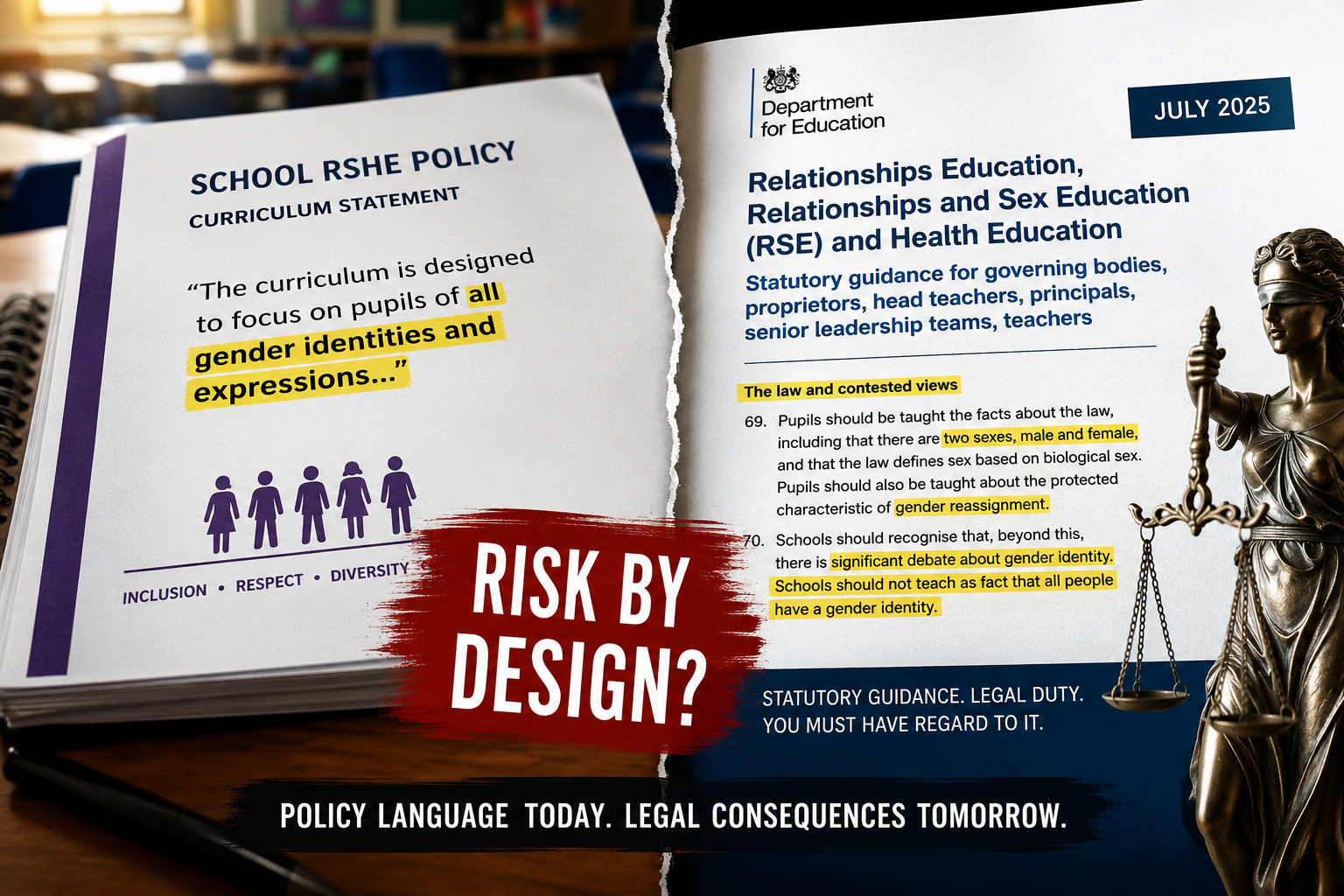
With revised statutory guidance on Relationships, Sex and Health Education (RSHE), issued in July 2025 and due to come into force in September 2026, schools are now entering a critical transitional phase of policy alignment. A serious question must therefore be asked: are some of the very policy templates relied upon by schools placing them at risk of future non-compliance with the law?
This question has moved from abstraction to reality following concerns raised about model RSHE policies circulated by The Key, a provider whose materials are widely used across English schools and trusts. Where such organisations position themselves as authoritative sources of compliant policy, the implications of their wording extend far beyond individual institutions.
This is not a theoretical concern. It arises from the growing use of model RSHE policies produced by external providers and adopted—often with minimal amendment—by governing bodies across the country. The issue is not whether such providers intend to mislead, but whether the language embedded within their templates can be reconciled with the statutory framework schools are required to follow. This is therefore not a post-compliance critique, but a pre-implementation warning: the language schools adopt now will determine whether they are compliant when the guidance takes effect.
The stakes are higher than many realise. This is not merely a matter of educational philosophy. It is a question of legal compliance, safeguarding responsibility, and governance accountability.
Statutory Guidance Is Not Optional
The starting point must be the legal status of the RSHE guidance itself. The Department for Education is explicit: this is statutory guidance issued under the Education Acts, and schools “must have regard to the guidance,” meaning that any departure requires clear, reasoned, and defensible justification.¹ This establishes not merely a recommendation, but a binding interpretive framework within which policy must be formed.
The responsibility for ensuring this compliance does not lie with external providers, however influential, but with those charged with governance. The guidance is addressed directly to governing bodies, trustees, proprietors, and senior leadership teams, who bear ultimate responsibility for policy adoption and implementation.²
This responsibility is reinforced by a further statutory expectation: schools must maintain an up-to-date RSHE policy and proactively engage and consult parents, ensuring transparency and accessibility of materials.³
The Critical Distinction: Law Versus Contested Belief
The revised guidance is notably careful—indeed deliberate—in its handling of sensitive and contested subject matter. Pupils must be taught about protected characteristics, including sexual orientation and gender reassignment, in a way that fosters respect and dignity.⁴ At the same time, schools are required to teach the facts and the law, including the distinction between biological sex and gender reassignment.⁵
Crucially, the guidance introduces a limiting principle: schools must recognise that beyond the law there is “significant debate” and must not present any particular view as settled fact.⁶ This is made explicit in the directive that schools should not teach as fact that all people have a gender identity.⁷
This is reinforced elsewhere in the guidance, which emphasises that RSHE must equip pupils with knowledge of the law and that teaching must remain grounded in factual, evidence-based content rather than ideological assertion.⁸
Where Template Policy Language Becomes Legally Vulnerable
It is precisely at this point that difficulties arise with certain externally supplied policy templates, including those attributed to The Key.
A commonly circulated formulation states:
“The curriculum is designed to focus on pupils of all gender identities and expressions…”⁹

The intention behind such language may well be inclusion. Yet intention is not the relevant legal test. The question is how such wording may reasonably be interpreted in light of statutory guidance.
On its face, the phrase assumes the existence of “gender identities and expressions” as a general and organising feature of human reality. It does not frame this as a contested idea, nor as one perspective among others. It presents it descriptively, as though it were a settled anthropological given.
In doing so, the wording is capable of being read as treating gender identity as an established and universal fact rather than a contested concept. That is precisely the formulation the statutory guidance cautions schools to avoid.
The Equality Act Distinction That Cannot Be Ignored
The legal framework reinforces this concern. The Equality Act 2010 protects the characteristic of gender reassignment, a defined legal category relating to individuals undergoing or proposing to undergo a process of transition.¹⁰
The statutory guidance reflects this distinction with precision, referring consistently to biological sex and gender reassignment as the relevant legal categories.⁵ Where policy language substitutes these with broader and undefined notions of “gender identity,” it risks blurring the line between law and ideology.
For a school, this is not an abstract concern. It goes directly to the requirement that pupils be taught the law as it stands, not as it is reinterpreted through contested theoretical frameworks.
Governance Cannot Be Outsourced
The statutory guidance is clear that governing bodies and proprietors are responsible for ensuring compliance, and that any departure from guidance must be justified.¹² The use of external templates—even those widely adopted—does not transfer that responsibility.
Schools must be able to demonstrate that their policies align with statutory expectations, particularly in light of strengthened requirements for parental engagement and transparency.³
Safeguarding Requires Clarity, Not Assumption
The issue is not solely legal. It is also deeply pastoral.
Keeping Children Safe in Education 2025 defines safeguarding as protecting children from harm and preventing impairment of their mental and physical development.¹¹ It emphasises that safeguarding is a child-centred responsibility requiring careful, informed, and proportionate responses to complex needs.¹¹
The RSHE guidance similarly warns against simplistic approaches, noting that issues such as identity and distress must be handled with care and that teaching must remain evidence-based and developmentally appropriate.⁷
Where policy language implicitly affirms contested frameworks as universal, it risks shaping pastoral responses in ways that are insufficiently cautious. Safeguarding demands clarity, not assumption.
From Assumption to Accountability
What is emerging, therefore, is not a marginal technical inconsistency but a systemic risk.
A single phrase, embedded now, may move a school from anticipated compliance into immediate contestation the moment the guidance comes into force.
The responsibility now rests with governors, trustees, and school leaders to ensure that policy reflects law, evidence, and the best interests of the child.
A school that cannot distinguish between law and ideology cannot claim neutrality; and a policy that cannot withstand scrutiny cannot credibly claim compliance.
¹ Department for Education, Relationships Education, Relationships and Sex Education (RSE) and Health Education (Statutory Guidance, July 2025), para. 5 (“must have regard”).
² Ibid., para. 9 (audience: governing bodies, trustees, SLT).
³ Ibid., paras. 12–13 (policy requirement and parental consultation).
⁴ Ibid., paras. 67–68 (“Lesbian, Gay, Bisexual and Transgender content” section, p.36 of guidance).
⁵ Ibid., para. 69 (teaching the facts and law relating to biological sex and gender reassignment, p.36).
⁶ Ibid., para. 70 (recognition of “significant debate” beyond the law, p.36).
⁷ Ibid., para. 70 (instruction not to teach as fact that all people have a gender identity; caution regarding social transition, p.36).
⁸ Ibid., section “Teaching about the law.”
⁹ Model RSHE policy wording circulated by school governance providers, including The Key (2026 template; wording as reproduced in circulated policy extract).
¹⁰ Equality Act 2010, s.7 (protected characteristic: gender reassignment).
¹¹ Department for Education, Keeping Children Safe in Education 2025, Part One (definition of safeguarding including prevention of impairment of development).
¹² Department for Education, Relationships Education… (2025), para. 5 (duty to justify departure from statutory guidance).