
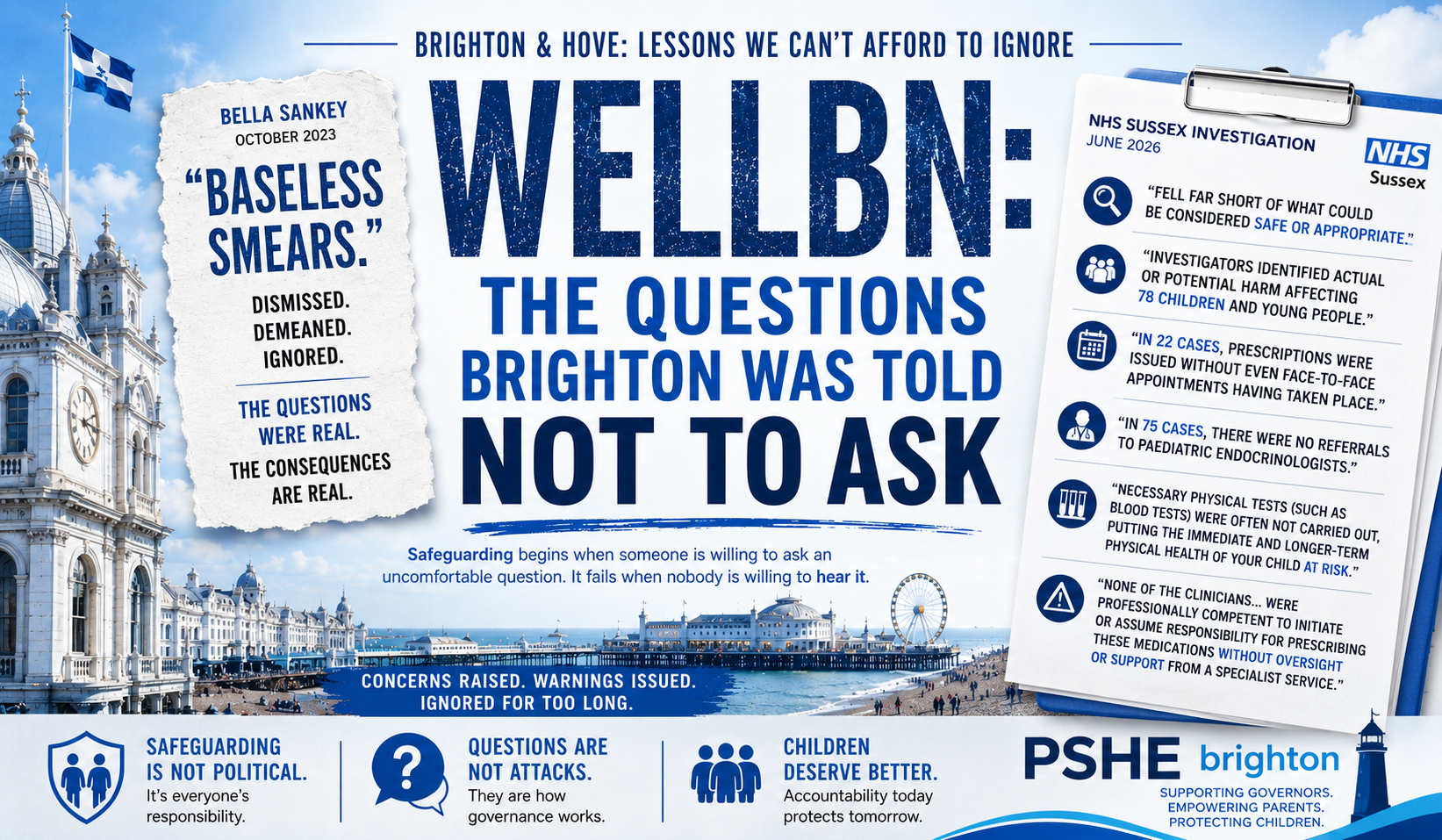
“Fell far short of what could be considered safe or appropriate.”
Those are not the words of campaigners, journalists, politicians, or critics.
They are the words used by NHS Sussex to describe the care provided to children and young people receiving gender-related hormone treatment through WellBN in Brighton.¹
The investigation’s findings are stark.
Investigators identified 78 children and young people who may have experienced actual or potential harm. They found that, in 22 cases, prescriptions were issued without a face-to-face consultation. In 75 cases, there had been no referral to a paediatric endocrinologist. Necessary physical monitoring was often absent. Blood tests were frequently not undertaken. Records relating to assessment, consent, and follow-up were found wanting. Most strikingly of all, investigators concluded that none of the clinicians whose care was reviewed were professionally competent to initiate or assume responsibility for prescribing these medications without specialist support or oversight.²
These are not minor procedural failings.
They are findings that strike at the heart of safeguarding, governance, professional accountability, and public trust.
For the young people and families directly affected, the consequences are deeply personal. For Brighton and Hove as a whole, however, the WellBN investigation raises a wider and more uncomfortable question:
How were legitimate safeguarding concerns treated when they were first raised?
The Questions Were Always About Safeguarding
Much of the public debate surrounding gender identity has been characterised as a political or ideological dispute.
The WellBN investigation reveals something different.
At its core, this was always a safeguarding issue.
The questions now being asked by NHS investigators are remarkably similar to the questions parents, campaigners, and concerned professionals have been asking for years.
Were proper assessments carried out
Were alternative explanations explored?
Were parents appropriately involved?
Were risks properly evaluated?
Was informed consent genuinely possible?
Were children receiving evidence-based care?
These are not partisan questions.
They are the ordinary questions that responsible adults ask whenever vulnerable children are involved.
The significance of the WellBN investigation therefore extends far beyond one GP practice. It forces us to examine how institutions respond when safeguarding concerns challenge prevailing assumptions.
Brighton’s Long Journey from Certainty to Scrutiny
To understand why this matters, it is necessary to understand Brighton’s recent history.
For more than a decade, Brighton and Hove was frequently presented as a model of progressive practice in matters relating to gender identity. The city’s Trans Inclusion Schools Toolkit was widely promoted. Schools, public bodies, and healthcare providers were encouraged to adopt approaches centred upon affirmation, social transition, and gender identity.
Those who questioned aspects of these approaches were often assured that professional consensus was settled.
Yet the trajectory of events over recent years tells a different story.
First came growing international concern about the evidence base underpinning medical interventions for children experiencing gender-related distress.
Then came the Cass Review.
Dr Hilary Cass’s independent review concluded that the evidence supporting many interventions was unexpectedly weak and that young people were often entering treatment pathways without the rigorous assessment processes normally expected for interventions carrying potentially significant and irreversible consequences.³
NHS England subsequently ended the routine prescribing of puberty blockers for children outside formal research settings and fundamentally revised its model of care.⁴
Now NHS Sussex has conducted a major patient safety investigation into WellBN.
The trajectory matters.
For years Brighton was presented as a model.
Then the assumptions underpinning that model were challenged.
Then national policy changed.
Now local practice has been subjected to formal investigation.
The lesson is not that every concern raised by parents was necessarily correct.
The lesson is that many concerns dismissed as unnecessary, exaggerated, or alarmist turned out to be worthy of serious examination.
When Concerns Became “Baseless Smears”
One episode in particular now takes on a significance that was perhaps not obvious at the time.
In 2023, community activist Adrian Hart, speaking in connection with concerns raised through PSHEbrighton, challenged Brighton & Hove City Council regarding safeguarding concerns associated with local gender identity policies. The issues included parental notification, social transition, breast binding, safeguarding oversight, and the operation of the Trans Inclusion Schools Toolkit.
In response, Council Leader Bella Sankey described the claims and accusations being made as “baseless smears.”⁵
Looking back, that exchange deserves careful reflection.
Parents were not demanding that schools adopt a particular ideology.
They were asking whether safeguarding procedures were being followed.
They were asking whether parents should be informed when significant interventions were taking place.
They were asking whether vulnerable children experiencing distress should receive careful assessment rather than automatic affirmation.
Those questions were characterised as smears.
Three years later, NHS Sussex concluded that care had “fallen far short of what could be considered safe or appropriate.”
No serious person claims that every concern raised by parents was correct.
That is not the point.
The question is whether those concerns were examined with the seriousness that safeguarding demands.
The WellBN investigation suggests that, too often, they were not.
The Cost of Institutional Certainty
There is a deeper lesson here.
The central lesson of the Cass Review and the WellBN investigation is not that one side of a political argument was entirely right and the other entirely wrong.
It is that institutions dealing with vulnerable children should proceed with humility.
Where evidence is uncertain, caution is a virtue.
Where consequences may be irreversible, scrutiny is a necessity.
And where safeguarding concerns are raised, they should be examined rather than dismissed.
Institutions are most vulnerable when a prevailing orthodoxy becomes so dominant that questioning it is treated as evidence of bad faith. At that point scrutiny declines, challenge diminishes, and governance weakens.
The result is not better safeguarding.
It is poorer safeguarding.
The WellBN investigation should remind every public body that safeguarding depends upon a culture in which difficult questions are welcomed rather than discouraged.
Public confidence is strengthened not when institutions claim certainty, but when they demonstrate a willingness to test their own assumptions.
Why Governors Should Read This Report
The lessons of WellBN extend far beyond healthcare.
Every governor in Brighton and Hove should read the investigation.
Not because schools are healthcare providers, but because the questions NHS investigators are now asking are precisely the questions governors are expected to ask of school leaders.
How are safeguarding risks assessed?
How are parents involved?
What evidence underpins policy decisions?
How are competing rights balanced?
Who is accountable when concerns are raised?
What mechanisms exist for challenge and scrutiny?
Governors are not ceremonial figures. They carry statutory responsibilities relating to safeguarding, child welfare, legal compliance, risk management, and accountability.⁶
Moreover, governors now operate in a markedly different environment from that which existed when many current policies were first introduced. The Cass Review, revised NHS guidance, the Supreme Court’s clarification of the meaning of sex in law, updated EHRC guidance, and evolving safeguarding requirements all require careful consideration.⁷
The purpose of governance is not to ratify decisions already made elsewhere.
The purpose of governance is to ask difficult questions before problems become scandals.
Why PSHEbrighton’s Campaign Matters
This is why PSHEbrighton’s current governor campaign matters.
The campaign did not emerge because of WellBN.
Rather, WellBN demonstrates why the campaign is necessary.
In May 2026, PSHEbrighton issued an Open Letter to Governors together with a detailed safeguarding briefing outlining the responsibilities governing bodies carry towards pupils, parents, and staff.⁸ The organisation subsequently launched its Ask Your School campaign, providing parents with practical questions they can raise with governors and school leaders regarding safeguarding, parental engagement, confidentiality arrangements, external providers, sex-based rights, policy transparency, and legal compliance.⁹
The purpose of the campaign is not to refight old ideological battles.
It is to ensure that governors understand their responsibilities before problems emerge.
The city has already experienced what happens when concerns are dismissed and assumptions go unchallenged.
The lesson of WellBN is that accountability delayed is accountability denied.
A Lesson Brighton Cannot Afford to Ignore
Before the findings were published, residents addressing Brighton & Hove’s Health & Wellbeing Board warned that NHS England had already identified indications that patient harm may have occurred and questioned whether concerns had been acted upon promptly enough.¹⁰
Those warnings deserve reflection.
The issue is not merely that mistakes were made.
The issue is that warnings were raised.
Questions were asked.
Concerns were voiced.
And too often those concerns were dismissed rather than examined.
The children identified in the WellBN investigation cannot be given back the years in which these questions should have been asked.
The responsibility now falls upon every governor, head teacher, clinician, councillor, and public official in this city to ensure that future children do not pay the same price for institutional certainty.
Safeguarding begins when someone is willing to ask an uncomfortable question.
It fails when nobody is willing to hear it.
What Parents Can Do
Parents and carers who wish to engage constructively with their child’s school can begin by asking a simple question:
How do governors assure themselves that safeguarding remains at the centre of decision-making?
PSHEbrighton’s Ask Your School campaign provides a practical framework for these conversations and offers resources to help parents engage effectively with governors and school leaders.
The WellBN investigation demonstrates why this matters.
The best time to ask questions is before failures occur, not after they are exposed.
References
¹ NHS Sussex, Patient Safety Investigation into Gender-Related Prescribing at WellBN, 2026.
² NHS Sussex findings as reported in investigation summaries and contemporaneous reporting; see also Hannah Barnes, “Children Potentially Harmed by NHS Gender Treatments,” The Times, 11 June 2026.
³ Hilary Cass, Independent Review of Gender Identity Services for Children and Young People: Final Report (London: Department of Health and Social Care, 2024).
⁴ NHS England, Clinical Policy: Puberty Suppressing Hormones for Children and Adolescents who have Gender Incongruence/Dysphoria, March 2024.
⁵ Frank le Duc, “Parents seek apology from council leader for calling their concerns ‘baseless smears’,” Brighton & Hove News, 28 October 2023.
⁶ Department for Education, Keeping Children Safe in Education (2025); Governance Handbook.
⁷ UK Supreme Court, For Women Scotland Ltd v The Scottish Ministers [2025] UKSC; Equality and Human Rights Commission guidance; Department for Education safeguarding guidance.
⁸ PSHEbrighton, Open Letter to School Governors and Governor Safeguarding Briefing, May 2026.
⁹ PSHEbrighton, Ask Your School campaign resources, 2026.
¹⁰ Brighton & Hove Health & Wellbeing Board deputation concerning WellBN investigation, 2025.
News Reports
BBC: Dozens of children put at risk after gender care failures at GP clinic, inquiry finds https://www.bbc.com/news/articles/c932y3q09qro
Brighton & Hove News: Hove GP put kids at harm by prescribing hormones without proper assessment or monitoring, damning report finds https://www.brightonandhovenews.org/2026/06/11/hove-gp-put-kids-at-harm-by-prescribing-hormones-without-proper-assessment-or-monitoring-damning-report-finds/
The Telegraph: NHS clinic withdraws cross-sex drugs for 78 children https://www.telegraph.co.uk/news/2026/06/11/nhs-clinic-withdraws-cross-sex-drugs-78-children-sussex/
The Times: NHS clinic’s gender treatment may have harmed 78 children https://www.thetimes.com/uk/healthcare/article/children-potentially-harmed-nhs-gender-treatments-gfct62q00?eafs_enabled=false
AOLcom: Dozens of children put at risk after gender care failures at GP clinic, inquiry finds https://www.aol.com/articles/dozens-children-put-risk-gender-183536000.html
Healthwatch Brighton & Hove: Gender care for children and young people at WellBN General Practice https://www.healthwatchbrightonandhove.co.uk/news/2025-06-17/gender-care-children-and-young-people-wellbn-general-practice