
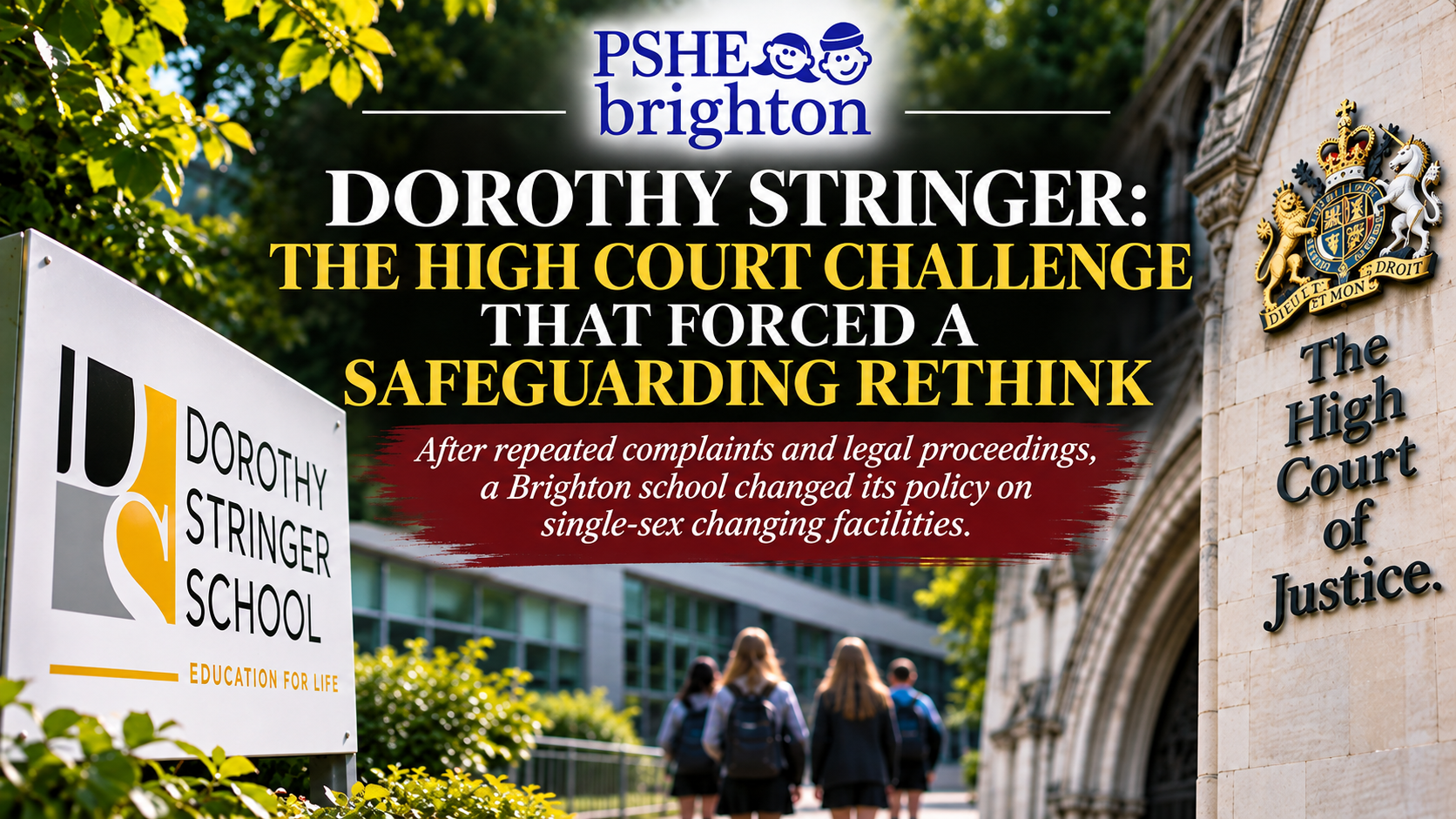
After repeated safeguarding complaints and High Court proceedings, a Brighton school has abandoned its practice of considering requests for access to opposite-sex changing facilities on a case-by-case basis. It denies that litigation influenced its decision, while Good Law Project claims victory. The court papers, the solicitors’ account and the school’s own governing records invite a rather different interpretation.
PSHEbrighton | 12 November 2026
On Tuesday 10 November, the High Court was due to hear arguments in a judicial review brought by a father and his teenage daughter against Dorothy Stringer School and Brighton & Hove City Council. The hearing, listed in the Administrative Court following an order made by Mrs Justice Foster, had been allocated two and a half hours. It would have considered whether the family’s challenge to the school’s changing-room arrangements should be permitted to proceed, together with several disputed procedural applications. By then, however, the proceedings had been withdrawn. The school had completed alterations to its facilities and supplied assurances which the family had been seeking since January 2025.¹
For the claimants, the outcome brought an end to a prolonged and expensive attempt to secure the privacy of a girl who had become uncomfortable using her school’s changing room. Their solicitors, Conrathe Gardner LLP, announced the result on 11 November as a significant climbdown by the school. Yet Dorothy Stringer told The Times that its change of policy had nothing to do with the litigation and resulted instead from the Government’s revised safeguarding guidance. Good Law Project, which had defended the previous arrangements and raised money for that defence, went further, announcing the withdrawal as a victory for its own position.²
The difficulty with these competing accounts is that the documentary chronology refuses to keep conveniently out of the way.
Dorothy Stringer is a large maintained secondary school in Brighton & Hove, educating approximately 1,600 pupils aged between eleven and sixteen. Its reputation for progressive educational practice has occasionally attracted national attention. In 2017, Tatler included it among the country’s most desirable state schools, praising its liberal atmosphere. An equality information report published the following year recorded forty pupils responding to a survey who said they did not identify with the gender presented at birth, while another thirty-six described themselves as gender-fluid. These were survey responses, not clinical assessments, but they illustrate that questions concerning gender identity were already prominent in the school’s educational environment several years before the present dispute.³
According to the family’s solicitors, Dorothy Stringer had operated arrangements for approximately three years under which requests from pupils identifying as transgender to use toilets and changing rooms designated for the opposite sex were assessed individually. A male pupil could therefore be permitted to use girls’ facilities following consideration of the circumstances. Other pupils using those facilities, and their parents, were not necessarily informed.
The practical consequences became apparent to one family in January 2025.
A teenage girl told her father that she believed a male pupil identifying as female had been sharing the girls’ changing room. Neither she nor her parents had been consulted about the arrangement. She became increasingly conscious of the pupil’s presence while changing and adjusted her behaviour to preserve her privacy. In the account subsequently published by Conrathe Gardner, she described covering herself more carefully and positioning her body so that less could be seen. She was also reluctant to complain openly because she feared being labelled transphobic or having her concerns dismissed.⁴
There is no allegation in the material examined that the transgender pupil behaved improperly. The complaint concerned the school’s decision to permit the arrangement and its consequences for another child’s privacy.
Her father approached Dorothy Stringer to establish what rules governed access to the facilities. He was informed, according to the solicitors, that requests from transgender pupils were considered individually. Dissatisfied with that explanation, he submitted five safeguarding complaints between January and May 2025, seeking assurances that his daughter would not be required to share intimate facilities with male pupils.
On 16 April 2025, the Supreme Court delivered its unanimous judgment in For Women Scotland Ltd v The Scottish Ministers. The Court held that the terms man, woman and sex in the Equality Act 2010 refer to biological sex, including where a person possesses a gender recognition certificate. It also confirmed that transgender people retain protection under the Act’s separate characteristic of gender reassignment.⁵
The father raised the implications of that judgment with the school, questioning whether arrangements permitting pupils to access intimate facilities according to their asserted gender identity could properly be reconciled with the legal distinction between male and female.
The school maintained its position.
Formal pre-action correspondence began in December 2025. According to Conrathe Gardner, Dorothy Stringer vigorously defended its case-by-case approach and declined at that stage to commit to the restrictions proposed in the Government’s forthcoming safeguarding guidance. The matter had passed through repeated safeguarding complaints, legal correspondence and a dispute over the school’s interpretation of its obligations.
In February 2026, the Department for Education published proposed revisions to Keeping Children Safe in Education. Among them were explicit provisions concerning single-sex toilets, changing rooms and requests from gender-questioning pupils. The proposals made clear that schools should not permit access to opposite-sex facilities where separation was required by law.⁶
In March, the father and daughter commenced judicial review proceedings. The claim, registered as AC-2026-LON-001527, named the governing board of Dorothy Stringer School as the first defendant and Brighton & Hove City Council as the second. It was brought before the High Court of Justice, King’s Bench Division, Administrative Court.
PSHEbrighton supported the family during the dispute.
The inclusion of the council was significant. Dorothy Stringer’s case-by-case approach reflected a framework expressly recommended in Brighton & Hove’s Trans Inclusion Schools Toolkit, a document developed through successive editions since 2013 and promoted to educational establishments throughout the city. The litigation consequently raised questions about local-authority guidance as well as the practice of an individual school.
On 24 June 2026, Mrs Justice Foster made an order addressing the conduct of the proceedings. She granted anonymity to both claimants because the case concerned a minor and involved sensitive information relating to welfare, education, medical circumstances and family life. The claimants are therefore identified in the court record as LIN and LIP, and publication of information likely to reveal their identities remains prohibited.⁷
The order also dealt with applications concerning extensions of time, expedition, expert evidence and the position of the minor claimant’s litigation friend. The defendants challenged aspects of the claim on procedural grounds, arguing that it had been brought late, that some issues were premature, and that forthcoming government guidance might render the proceedings academic. They also maintained that they possessed substantive answers capable of defeating the claim.
Mrs Justice Foster recognised that some of those arguments might prove decisive. She did not, however, dismiss the proceedings or determine whether the school’s former practice was lawful. Instead, she directed that the outstanding applications, including the application for permission to proceed with judicial review, should be considered at an inter partes oral hearing, allowing counsel for both sides to make submissions.
The hearing was allocated two and a half hours and was to be listed for the first suitable date after 1 October 2026. The judge declined expedition, expressly taking account of the changes to government guidance anticipated during the summer or early autumn. Permission for a substantive judicial review had therefore not yet been granted, but the proceedings were advancing towards a hearing at which the competing arguments would be examined.⁷
The eventual date was 10 November 2026.
This procedural history matters because subsequent commentary has treated the withdrawal as though the High Court had vindicated Dorothy Stringer’s position. It had done nothing of the kind. The legal challenge reached the stage of a scheduled oral permission hearing. The proceedings ended before that hearing took place, and no substantive judgment on the school’s former policy was delivered.
The school’s summer-term magazine, The Stringer Press, subsequently informed parents that the changing rooms would be refurbished during the summer holidays.⁸
Dorothy Stringer’s explanation to The Times is that the changes resulted from the Government’s guidance rather than the lawsuit, and that the family had been informed in April that the school would comply once the final guidance was published.
Even accepting that account, April 2026 was already several months into legal correspondence and followed the commencement of High Court proceedings. The assurance cited by the school was therefore given during the litigation.
There is a further difficulty with the suggestion that the proceedings played no part.
On 10 June 2026, Good Law Project publicly announced that it was defending a school whose existing case-by-case approach to toilets and changing rooms was being challenged by a pupil and her parent. The organisation explained that the claimants wanted access determined according to biological sex, while the school wished to retain discretion to assess individual requests from transgender pupils. Good Law Project argued that this discretion allowed lawful decisions which balanced competing interests and safeguarding duties.⁹
Its crowdfunding appeal defended the same approach. Good Law Project maintained that blanket restrictions would create serious concerns under equality and human-rights law, and sought donations towards the school’s defence. Its fundraising terms specified that ten per cent of funds raised would contribute towards the organisation’s general running costs, with any surplus supporting its wider work.¹⁰
These were public statements made after proceedings had begun and after the April assurance upon which Dorothy Stringer now relies. Good Law Project was defending the continued availability of the discretion which the family sought to remove.
On 2 July, its crowdfunding page announced that the claimants had failed to obtain expedition, explaining that their application for permission to pursue judicial review would be considered at an oral hearing no earlier than October. The proceedings remained active.
Five days later, on 7 July, the Department for Education published the final Keeping Children Safe in Education 2026 guidance, which came into force on 1 September.¹¹
Its requirements were considerably more explicit than the approach Dorothy Stringer had previously defended.
Paragraph 108 states that schools must not allow children into toilets designated for the opposite biological sex, including where a request arises from social transition. Paragraph 109 reiterates the requirement for separate toilets for boys and girls aged eight and over, subject to the statutory exception for individual toilets contained in rooms which can be secured from inside and are intended for one pupil at a time.
Paragraph 115 addresses changing rooms directly. Schools must prevent pupils aged eleven or over at the beginning of the school year from undressing before children of the opposite biological sex. When responding to requests concerning social transition, they must not permit access to changing rooms designated for the opposite sex.
Paragraph 117 requires schools to consider appropriate alternative arrangements for gender-questioning pupils who do not wish to use the facilities designated for their sex. A fully enclosed private room, secured from inside and used by one child at a time, or arrangements permitting facilities to be used at another time, may be appropriate. Such provision must preserve single-sex facilities and take account of the privacy and dignity of all pupils.
Paragraph 276 repeats the governing requirement: schools must not permit access to toilets, changing rooms or residential accommodation designated for the opposite sex, without exceptions.¹¹
These provisions do not dispense with a school’s duty to support transgender or gender-questioning children. Individual circumstances must still be considered, and the Equality Act’s protection against discrimination remains relevant. The difference is that a school cannot exercise discretion by granting access to the opposite sex’s designated facilities where the statutory requirements prohibit it. Its discretion concerns the alternative arrangements which may properly be made.
By October, according to Conrathe Gardner, Dorothy Stringer had confirmed that it would comply with the guidance and had supplied evidence of physical alterations to its toilets and changing rooms. The school eventually provided the assurances sought by the claimants, including confirmation that pupils would not be permitted to use changing rooms designated for the opposite biological sex or undress before pupils of that sex.¹
Good Law Project’s subsequent statement refers to the provision of private, gender-neutral spaces. The school has also said that its revised facilities afford every pupil privacy and dignity. The documents publicly examined establish the assurances about access and the existence of alterations, but do not provide a complete description of the resulting layout, the number or location of individual facilities, or the precise arrangements for their everyday use.
The former policy concerned discretionary access to opposite-sex facilities. The new guidance permits appropriate private alternatives without compromising single-sex provision. What the school has confirmed is that the former discretion will no longer operate in the manner challenged by the family.
Having obtained those assurances, the claimants agreed to withdraw their judicial review. The proceedings were formally withdrawn by consent before the High Court hearing due on 10 November. The solicitors’ release records that legal costs had not yet been determined.
Paul Conrathe described the outcome as a vindication of the father’s efforts and maintained that the school had abandoned an unlawful practice following proceedings which should never have been necessary. That assessment of unlawfulness remains his legal contention rather than a conclusion reached by the High Court. The practical change, however, is established.
The father described the personal cost of the dispute, explaining that his family had incurred financial expense and emotional strain in obtaining safeguards they believed should have existed without litigation. He also condemned the lack of information given to other girls and their parents concerning access to intimate facilities.
His daughter spoke of the damage to her confidence in the teachers and school she had previously trusted. Having spent so long seeking privacy in her changing room, she asked: “Why aren’t girls’ voices heard?”¹
It was against this background that Good Law Project announced its victory on 11 November.
The organisation’s statement, headed Win: Legal challenge against school’s inclusive approach withdrawn, asserted that the proceedings had been abandoned because the school’s facilities complied with the revised safeguarding guidance. It described Paul Conrathe as an anti-trans lawyer and his clients’ challenge as misguided. More strikingly, it declared: “This case wasn’t prompted by any problem.”¹²
There had been five safeguarding complaints. A girl had reported distress arising from the changing-room arrangements. Her father had sought clarification, pursued complaints, instructed solicitors and eventually commenced proceedings in the High Court.
The school was entitled to dispute his legal arguments and to defend its interpretation of its obligations. Whether its previous practice had been unlawful remained undecided. The existence of the family’s concerns, however, was hardly speculative.
Good Law Project’s account also fails to distinguish between different reasons for withdrawing litigation. A claimant may abandon a case because it lacks merit, because proceedings become prohibitively expensive, or because the defendant has supplied the remedy sought. The last of those explanations is the one given by Conrathe Gardner.
The organisation had publicly defended the school’s discretion to consider admission to opposite-sex facilities. The school ultimately adopted arrangements which excluded such admission. Good Law Project may welcome the provision of private alternatives for transgender pupils, which the final guidance expressly contemplates, but that does not establish that the earlier policy survived judicial scrutiny.
The LGBTQ publication Scene adopted an even more sweeping interpretation. Its editorial account, published on 11 November, described the challenge as having collapsed and asserted that there had been no complaint from a pupil or safeguarding failure. It suggested that withdrawal meant the case could not be sustained and that the school’s case-by-case model had been vindicated.¹³
The court record cannot support that conclusion. No substantive hearing occurred and no judgment was given on the former arrangements. Nor does the absence of a direct formal complaint from the girl, if that is what Scene intended, negate the five safeguarding complaints submitted by her father on her behalf.
It is particularly unfortunate when commentary professing concern for vulnerable children appears reluctant to acknowledge a child’s distress because her objection complicates its interpretation of the dispute.
The background to Dorothy Stringer’s practice is equally important.
On 23 January 2025, Brighton & Hove City Council’s Cabinet approved publication of Version 5 of its Trans Inclusion Schools Toolkit, recommending that educational establishments throughout the city use the guidance to inform their policies. The document continued an approach developed locally since 2013 and subsequently influential beyond Brighton.¹⁴
Section 4.3.3 advises that requests concerning the use of changing rooms by transgender pupils should be assessed individually, in discussion with the pupil concerned. It requires schools to consider the interests of other children, expressly including girls and pupils with relevant religious beliefs. Where a decision disadvantages those groups, the toolkit advises that the school must be able to justify that disadvantage.
The council therefore acknowledged that female pupils and children holding religious convictions possess interests deserving consideration. The difficulty lay in the underlying premise that access to an opposite-sex changing room remained a matter for negotiation, provided that the school believed it had balanced the competing interests.
Section 4.3.4 recommends that a pupil desiring greater privacy should generally be offered a reasonable alternative place or time to change.¹⁵
In practice, a school might permit a male pupil identifying as female to use the girls’ changing room, then offer another girl who objects a separate place to undress. The burden of adjusting to the arrangement could consequently fall upon the pupil seeking to preserve the ordinary separation of the sexes.
A girl’s desire for privacy does not depend upon believing that another pupil presents a physical danger. She may be entirely sympathetic towards a transgender classmate while remaining unwilling to undress in that pupil’s presence. Separate changing facilities have never required proof that members of the opposite sex are dangerous. Their provision recognises bodily privacy as a legitimate concern in itself, particularly during adolescence.
That principle ought to be central to safeguarding policy. Children have different physical, emotional and developmental needs, and schools must consider how their decisions affect all the pupils who use communal facilities. An adolescent’s wish to preserve bodily privacy is a legitimate concern whether or not that child can identify an additional risk of misconduct. The difficulty arises when a school treats such concerns primarily as obstacles to accommodating another pupil rather than as needs deserving consideration in their own right.
The toolkit’s provisions also raise questions about consultation. Although schools are instructed to consider the interests of other pupils, the Dorothy Stringer family maintains that neither the girl nor her parents knew that the relevant policy permitted access by male pupils following individual assessment.
Confidentiality concerning an individual transgender pupil’s circumstances is plainly important. It does not prevent a school from explaining its general policy on intimate facilities or from consulting parents about arrangements which may affect their children. If those affected are unaware of the policy, the school’s assessment of their interests risks becoming an exercise in deciding what they ought to think rather than discovering what they actually experience.
There is a further issue concerning the distinction between protecting confidential information and withholding the rules under which an institution operates. Parents do not need access to another child’s personal records to know whether school changing rooms are designated by biological sex, whether exceptions are permitted, or what alternatives exist for pupils with particular needs. Those are matters of general policy. A school ought to be able to explain them clearly without identifying or discussing an individual pupil.
Brighton & Hove City Council was the second defendant in the proceedings, and the policy framework being challenged had been formally recommended by its Cabinet. The relevant provisions of Version 5 remain in the published document examined for this article. That does not establish that the council has issued no further advice to schools, but the relationship between the published toolkit and the September statutory guidance requires clarification.
The council should explain whether schools relying upon its earlier recommendations have been instructed to amend their arrangements, whether the toolkit itself will be revised, and how the interests of female pupils are now being assessed when alternative accommodation is considered.
The issue is not confined to Dorothy Stringer. A toolkit formally recommended across a local authority area may influence the everyday decisions of headteachers, governing bodies and safeguarding staff in schools whose policies have never attracted public attention. If the published guidance can reasonably be understood as permitting arrangements now expressly prohibited in the national guidance, the responsibility to correct or clarify it falls upon the authority which recommended its use.
There are also lessons from earlier litigation concerning local-authority transgender guidance. In Oxfordshire, a challenge to schools guidance ended without a substantive judicial determination after the contested document was withdrawn. Such outcomes can provide practical remedies while leaving the legality of previous policies unresolved.¹⁶
Brighton now faces a similar situation. Dorothy Stringer has changed its arrangements, the claimants have withdrawn their proceedings, and no court has determined whether the former policy was unlawful. The immediate dispute has ended without resolving the wider questions of governance and accountability.
The controversy also draws attention to the physical requirements for school toilets and changing rooms. A room intended for individual use, secured from the inside, is materially different from a cubicle within a communal facility. The School Premises (England) Regulations 2012 establish requirements concerning toilet provision, and the revised safeguarding guidance explains the circumstances in which alternative individual facilities may be provided.¹⁷
Those distinctions matter because an institution may describe an arrangement as private or inclusive without establishing that it meets the relevant requirements in practice. Schools need to consider physical layout, access, supervision, pupil welfare and the consequences for other users. Policy language cannot substitute for the arrangements children encounter in everyday school life.
The revised Dorothy Stringer facilities have not been described in sufficient public detail to allow a complete independent assessment of their design. What is established is that the school provided the assurances required to resolve the claimants’ immediate concerns. The arrangements should now be documented clearly enough for pupils and parents to understand their operation.
This is particularly important in secondary education, where young people are developing a greater awareness of their bodies, personal boundaries and independence. Safeguarding should reinforce their confidence that legitimate concerns can be raised without embarrassment or fear of punishment. Children should be able to tell a teacher that an arrangement makes them uncomfortable without first having to consider whether doing so will be interpreted as an objection to another pupil’s identity.
Teachers themselves require clear policies. A member of staff asked to resolve a disagreement about intimate facilities should not have to improvise an answer from competing interpretations of equality law, local guidance and national safeguarding requirements. The rules need to be lawful, coherent and capable of being explained to families.
Parents likewise require confidence that the school’s safeguarding procedures are meaningful. Dorothy Stringer’s public response to The Times maintains that it has always complied with the law and sought to safeguard every pupil. It says that the revised arrangements provide privacy and dignity for girls, boys and transgender or gender-questioning children alike. That is the proper scope of its responsibilities.
What remains unexplained is why this family needed to pursue five safeguarding complaints, formal legal correspondence and High Court proceedings before receiving satisfactory assurances.
The school’s insistence that the litigation was irrelevant to its eventual decision is difficult to sustain without a fuller account of its decision-making process. The proceedings had already begun when the April assurance cited by the school was reportedly given. Good Law Project continued publicly defending the school’s discretion in June. The requested assurances were eventually provided in October, shortly before the scheduled hearing.
The revised government guidance may have determined the precise arrangements adopted by the school. That does not establish that the legal proceedings had no influence upon its decision. The solicitors’ account attributes the change to the pressure of the litigation, and the chronology provides substantial grounds for taking that explanation seriously.
The governing board could resolve much of the uncertainty by explaining when it first decided that opposite-sex access would cease, what prompted the changing-room adaptations and why the assurances eventually given in October had not been supplied earlier. It should also clarify how the complaints were considered and how pupils and parents were informed of the relevant policy.
The council has corresponding responsibilities. It should establish the current status of its Trans Inclusion Schools Toolkit, clarify whether all local schools have been given appropriate advice following the national guidance, and ensure that safeguarding complaints concerning intimate facilities are examined without assumptions about the legitimacy of the concerns being raised.
For the family, the practical objective has been achieved. The High Court proceedings ended by consent before the oral permission hearing on 10 November, without a substantive judicial finding and with legal costs still unresolved at the time of the solicitors’ announcement.
The broader issue is whether the institutions responsible will acknowledge what the proceedings revealed. A father spent nearly two years pursuing concerns about his daughter’s privacy, eventually obtaining satisfactory assurances only after the dispute had reached the High Court. The school has altered its arrangements, but its treatment of the earlier complaints and the chronology of its decision remain matters of legitimate public interest.
Children and parents should not require access to judicial review proceedings to establish what rules govern the use of school toilets and changing rooms. They should be able to understand those rules, raise concerns about them and receive informed answers from the institutions entrusted with safeguarding pupils.
Dorothy Stringer and Brighton & Hove City Council have yet to provide an equally satisfactory account of the policies and decisions which brought this matter before the Court.
¹ Conrathe Gardner LLP, Brighton School Drops ‘Secret’ Policy Allowing Biological Boys To Use Girls’ Changing Rooms After Legal Challenge, press release, 11 November 2026, pp. 1–4.
² Sanchez Manning, ‘Cool’ Brighton school reconsiders trans changing room policy, The Times, 11 November 2026; Good Law Project, Win: Legal challenge against school’s inclusive approach withdrawn, 11 November 2026.
³ Sanchez Manning, ‘Cool’ Brighton school reconsiders trans changing room policy, The Times, 11 November 2026.
⁴ Conrathe Gardner LLP, Brighton School Drops ‘Secret’ Policy, 11 November 2026, pp. 1–3.
⁵ UK Supreme Court, For Women Scotland Ltd v The Scottish Ministers, [2025] UKSC 16, judgment of 16 April 2025.
⁶ Department for Education, Keeping Children Safe in Education: Proposed Revisions 2026, February 2026.
⁷ Courts and Tribunals Judiciary, LIN and LIP v The Governing Board of Dorothy Stringer School and another, Administrative Court, claim AC-2026-LON-001527, order of Mrs Justice Foster, 24 June 2026.
⁸ Dorothy Stringer School, The Stringer Press: Summer Term 2026, Headteacher’s message, July 2026.
⁹ Good Law Project, Fighting for trans kids to feel safe at school, 10 June 2026.
¹⁰ Good Law Project, Defend trans kids in school, crowdfunding appeal and update of 2 July 2026.
¹¹ Department for Education, Keeping Children Safe in Education 2026, published 7 July 2026, effective 1 September 2026, paragraphs 108–118 and 276.
¹² Good Law Project, Win: Legal challenge against school’s inclusive approach withdrawn, 11 November 2026.
¹³ Scene, Legal challenge against trans inclusive school withdrawn in win for Good Law Project, 11 November 2026.
¹⁴ Brighton & Hove City Council, Cabinet Decision: Trans Inclusion Schools Toolkit Version 5, 23 January 2025.
¹⁵ Brighton & Hove City Council, Trans Inclusion Schools Toolkit Version 5, sections 4.3.3–4.3.4.
¹⁶ Oxfordshire County Council, Statement on the Trans Inclusion Toolkit, 20 December 2019, updated 4 May 2020.
¹⁷ School Premises (England) Regulations 2012, regulation 4; Department for Education, Keeping Children Safe in Education 2026, paragraphs 108–118.


